Not sure whether to repair or replace your flat roof in California? This guide breaks down the key signs, costs, and decision factors to help you choose the right path.
What Are the Main Differences Between Flat Roof Repair and Replacement?
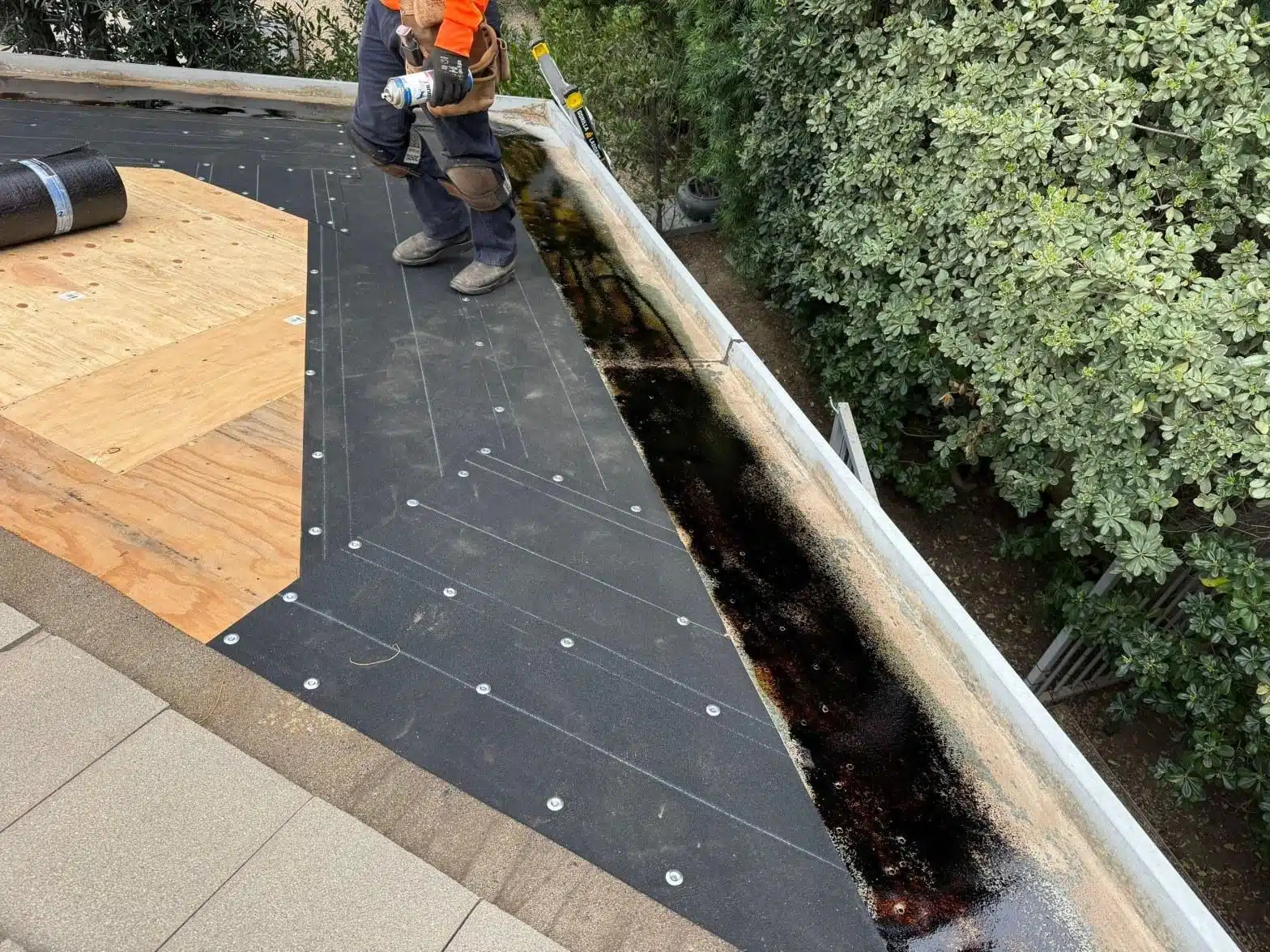
Flat roof repair fixes a specific damaged section, a patch, a failed seam, a cracked flashing, without touching the rest of the membrane. Replacement removes the entire existing system down to the deck and installs a new one. The two services are not interchangeable, and choosing the wrong one can cost thousands of dollars more in the long run.
Repair is a targeted fix. A contractor locates the leak source, cuts out the compromised material, and bonds in new membrane or sealant. The job is usually done in a single day and disrupts very little of the existing roof.
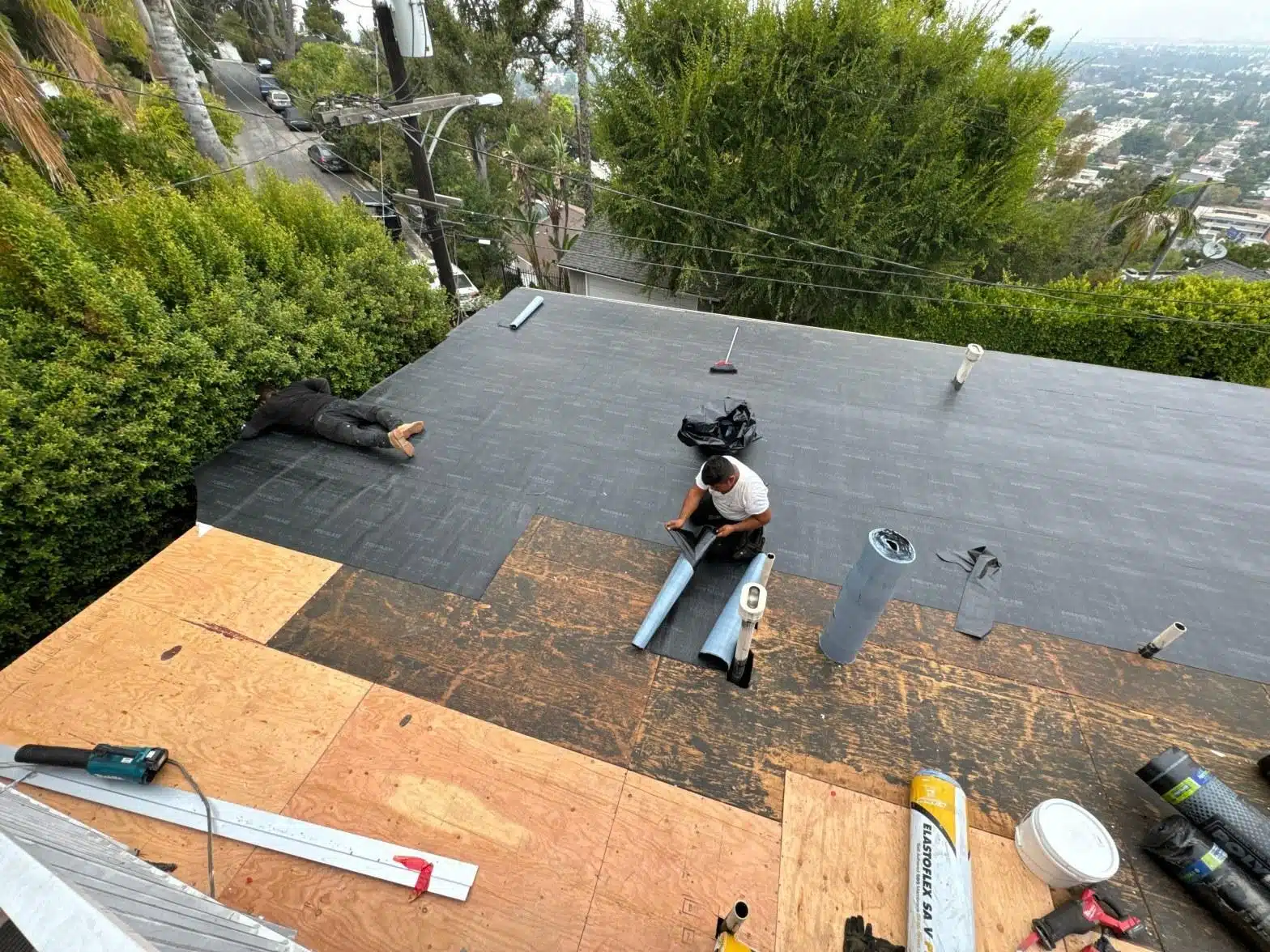
Replacement is a full system reset. Workers tear off the old membrane, inspect the plywood or concrete deck underneath, repair any rotted or damaged substrate, and install a brand-new waterproofing system from scratch. It takes longer, costs more upfront, and triggers California’s Title 24 building energy standards compliance requirements for the new assembly.
What Are the Warning Signs Your Flat Roof Needs Attention?
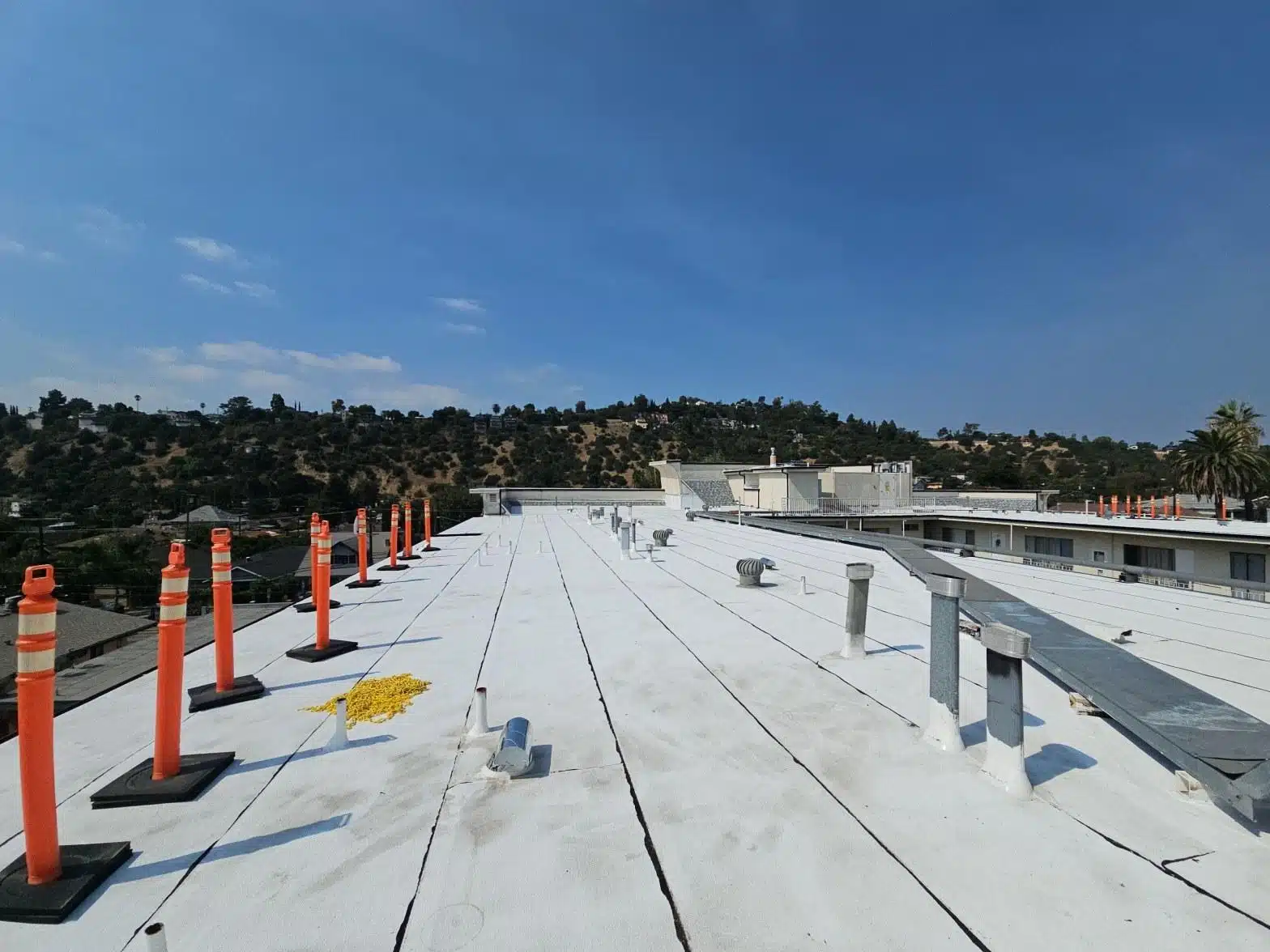
Standing water that remains more than 48 hours after rain, visible bubbles or blisters in the membrane, and water stains on interior ceilings are the three most common signs that a flat roof needs professional evaluation. Some signs point toward repair; others point toward full replacement.
Signs that typically call for repair:
- Isolated blistering or bubbling: Air or moisture trapped under a small section of membrane, usually fixable by cutting out and re-bonding that area.
- Cracked or lifted flashing: Metal flashing around vents, skylights, or parapet walls separates over time and lets water in at the edge.
- Single-point leak after a storm: A puncture from debris or a failed seam that is easy to locate and patch.
- Minor pooling in one low spot: A small drainage issue that can be corrected with a tapered insulation insert or drain adjustment.
Signs that typically call for replacement:
- Multiple leaks in different areas: When water is entering through three or more separate points, the membrane has failed system-wide.
- Widespread alligatoring: A cracked, scaly surface pattern across most of the roof means the material has lost its flexibility and cannot be patched reliably.
- Soft or spongy deck: If the substrate flexes underfoot, the wood has absorbed moisture and is rotting, repair alone will not fix this.
- Roof older than 20 years: Most flat roof membranes are rated for 15 to 25 years. A system past its design life is a replacement candidate even if it looks intact.
- Interior mold or persistent ceiling stains: Long-term water intrusion that has reached insulation or framing usually means the damage is deeper than a surface patch can address.
Our team responds to roughly 3 times more emergency flat roof calls in the wet months of December through March than during the dry summer season, and in the majority of those calls, the leak had been building undetected for at least one full season before it showed up inside the home.
Flat Roof Repair vs. Replacement California: How to Make the Call
The clearest way to decide on flat roof repair vs. replacement California homeowners face is the 50% rule: if repairing the damaged area would cost more than 50% of a full replacement, replacing the whole roof is the smarter investment. Below that threshold, repair is usually the right move, above it, you are spending good money on a system that is already failing.
If repairing the damaged area would cost more than 50% of a full replacement, replacing the whole roof is the smarter investment.
Use this decision table as a starting framework:
| Factor | Points Toward Repair | Points Toward Replacement |
|---|---|---|
| Roof age | Under 15 years old | 15 years or older |
| Leak locations | 1-2 isolated spots | 3 or more separate areas |
| Membrane condition | Mostly intact, minor damage | Widespread cracking or alligatoring |
| Deck condition | Solid, no soft spots | Rotted, spongy, or delaminated |
| Repair cost vs. replacement cost | Under 50% of replacement cost | Over 50% of replacement cost |
| Number of previous repairs | None or one prior patch | Two or more prior repairs in same area |
| Energy performance | Insulation still effective | Insulation saturated or degraded |
California’s climate adds a layer of complexity that does not apply in other states. The intense UV radiation in Southern California, especially in inland valleys and desert-adjacent communities, degrades membrane materials faster than in cooler climates. NOAA climate data shows that parts of Southern California average more than 280 sunny days per year, which accelerates oxidation of older TPO, EPDM, and built-up roofing systems. A roof that might last 20 years in the Pacific Northwest may need attention at 15 years in the Los Angeles basin.
Parts of Southern California average more than 280 sunny days per year, which accelerates oxidation of older TPO, EPDM, and built-up roofing systems.
California also requires that any re-roofing project meet current Title 24 energy standards, which means a replacement will typically require cool-roof-rated materials with a minimum Solar Reflectance Index (SRI) value. Repair work on an existing membrane generally does not trigger this requirement, which is one reason repair is sometimes the more cost-effective short-term choice even when the roof is aging.
What Does Flat Roof Repair or Replacement Cost in California?
Flat roof repair in the California market typically ranges from $400 to $3,500 depending on the size of the damaged area, the membrane type, and how accessible the roof is. Full replacement projects generally range from $5,000 to $20,000 or more for a residential flat roof. Both ranges shift significantly based on the factors below.
Key cost factors for repair:
- Damage area size: A 10-square-foot patch costs far less than a 200-square-foot section repair.
- Membrane type: TPO and EPDM patches are generally less expensive than modified bitumen or built-up roofing repairs, which require heat or torch work.
- Deck damage: If the substrate needs replacement before the membrane can be patched, costs rise by several hundred to over a thousand dollars.
- Emergency access: After-hours or storm-emergency calls typically carry a premium.
Key cost factors for replacement:
- Roof square footage: Most contractors price flat roofing by the square (100 sq ft). A 1,500-square-foot roof costs more than twice what a 700-square-foot roof costs.
- Material choice: TPO and EPDM single-ply membranes are generally the most affordable options. PVC membranes and spray polyurethane foam (SPF) systems typically cost more but offer longer service lives.
- Tear-off layers: California building codes generally limit the number of roof layers that can be stacked. If an existing layer must be torn off before installation, that adds labor and disposal costs.
- Insulation upgrades: Meeting Title 24 requirements may require adding or upgrading rigid insulation, which adds to the project total.
The ENERGY STAR program certifies cool-roof products that can qualify for utility rebates in California, which can offset a portion of replacement costs. Programs like TECH Clean California also periodically offer incentives for energy-efficient building envelope upgrades, worth asking your contractor about before signing a contract.
For a precise number on your specific roof, request a custom quote from a licensed contractor who can physically inspect the deck, membrane, and drainage.
Which Flat Roof Materials Work Best in California’s Climate?
TPO (thermoplastic polyolefin) and cool-roof-rated EPDM are the two most widely used flat roof membranes in California because both reflect UV radiation, meet Title 24 requirements, and hold up well through the region’s dry summers and periodic heavy rain events. The best choice depends on your budget, roof slope, and how long you plan to stay in the home.
Here is a quick breakdown of the most common options:
- TPO single-ply: Heat-welded seams make it highly watertight. Reflective white surface meets cool-roof standards without additional coating. Typical service life of 15 to 25 years in California conditions.
- EPDM (rubber membrane): Extremely durable and flexible through temperature swings. Black EPDM absorbs heat, so cool-roof-rated white EPDM or a reflective coating is recommended for California compliance. Service life of 20 to 30 years with proper maintenance.
- Modified bitumen: A multi-layer system that handles foot traffic well, useful on roofs with rooftop equipment or HVAC units. Torch-applied or cold-applied. Service life of 15 to 20 years.
- PVC membrane: Chemical-resistant and highly durable at seams. Good for roofs near kitchen exhaust or HVAC condensate. Generally the highest upfront cost among single-ply options.
- Spray polyurethane foam (SPF): Seamless application eliminates most leak points. Excellent insulation value. Requires a UV-protective top coat and periodic recoating every 5 to 10 years, but the base foam can last 30 or more years if maintained.
- Built-up roofing (BUR): Multiple layers of bitumen and reinforcing fabric. Time-tested system that has been used on California commercial and residential buildings for decades. Heavier than single-ply systems.
What Do Roofing Contractors in California Actually Do During Each Service?
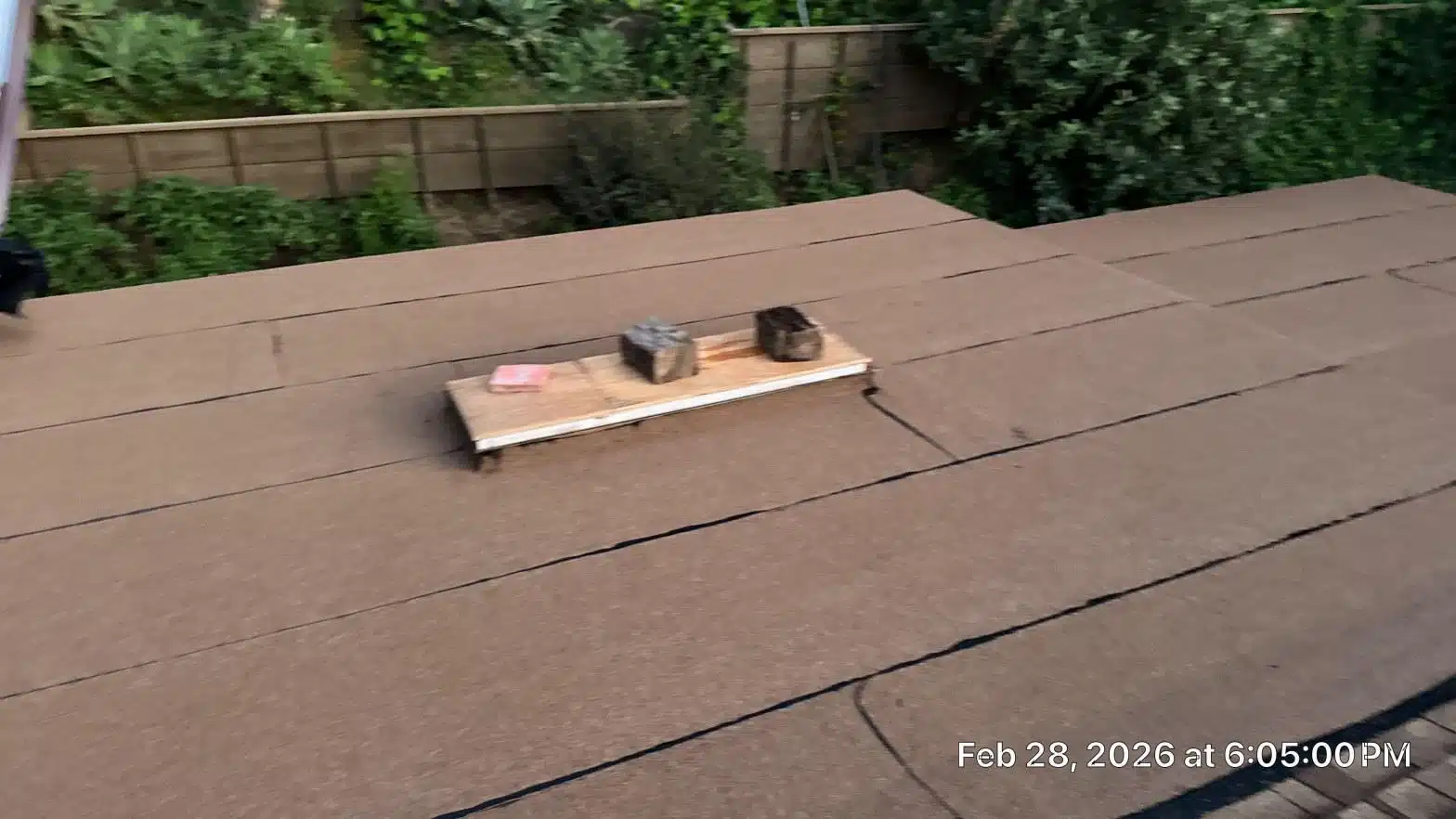
A qualified roofing contractor begins both repair and replacement jobs with a full inspection, not just a look at the obvious wet spot, because flat roof leaks routinely enter at one point and travel several feet before showing up inside the building. Skipping this step is the most common reason a repair fails within a year.
What a professional flat roof repair involves:
- Full roof walkthrough to identify all damaged areas, not just the reported leak.
- Moisture probing or infrared scan to locate saturated insulation hidden under intact-looking membrane.
- Cutting out the damaged membrane section with clean, straight edges at least 6 inches beyond the visible damage.
- Inspecting and drying the deck below before any new material goes down.
- Installing a compatible patch membrane bonded with the correct adhesive or heat-welded to match the existing system.
- Sealing all edges and testing the repair area before leaving the site.
What a professional flat roof replacement involves:
- Full tear-off of existing membrane layers down to the structural deck.
- Deck inspection and repair of any rotted, delaminated, or damaged sheathing.
- Installation of code-compliant insulation to meet California’s Title 24 R-value requirements.
- Installation of the new membrane system with manufacturer-specified fastening, adhesive, or heat-welding methods.
- Flashing installation at all penetrations, edges, and parapet walls.
- Final inspection and documentation for permit close-out where required.
Roofing contractors in California who perform this work should be licensed by the California Contractors State License Board (CSLB) under a C-39 roofing license. Always verify a contractor’s license number on the CSLB website before signing a contract. Across our flat roof service calls in Southern California, we find that roughly 40% of roofs brought in for a single-leak repair have at least one additional problem area that the homeowner was not aware of, which is why a full inspection matters before any work begins.
Roughly 40% of roofs brought in for a single-leak repair have at least one additional problem area the homeowner was not aware of.
Get the Right Answer for Your Roof
Deciding between flat roof repair vs. replacement California homeowners face comes down to the age of the system, the extent of the damage, and what a full inspection reveals about the deck underneath. A targeted repair can add years of life to a healthy roof. A failing system that keeps leaking through repeated patches is costing you money every season it goes unreplaced.
Roof Repair & Construction Inc. serves homeowners and property owners across Southern California with honest, inspection-first flat roof evaluations. Whether your roof needs a targeted patch or a full new membrane system, the team will walk you through the options and costs before any work begins.
Call (323) 474-1088 to schedule your flat roof inspection. Get a written assessment and a clear recommendation, repair or replace, so you can make an informed decision before the next rainy season arrives.
Explore our full range of Roof Repair services across Southern California.
Frequently Asked Questions
How do I know if my flat roof leak needs a repair or a full replacement?
If the leak is coming from one or two isolated spots and the rest of the membrane is in good shape, a targeted repair is usually enough. If you have multiple leaks in different areas, widespread surface cracking, or a roof older than 15 to 20 years, replacement is likely the more cost-effective long-term solution. A professional inspection with moisture probing will give you the clearest answer.
How do I find where a flat roof is leaking?
Flat roof leaks are tricky because water enters at one point and can travel several feet along the membrane or insulation before showing up inside. Start by checking flashings around vents, skylights, and parapet walls; these are the most common failure points. A roofing contractor can use an infrared scan to locate saturated insulation under an otherwise intact-looking surface, which is the most reliable way to find hidden leak paths.
How long does a flat roof repair typically last?
A properly done flat roof repair on a membrane that is still in good overall condition can last 5 to 10 years or more. If the surrounding membrane is already degraded or the repair is on a roof older than 15 years, the patch may hold for only a season or two before new problems appear nearby. The condition of the rest of the roof matters as much as the quality of the repair itself.
What is the average cost of flat roof repair in California?
In the California market, flat roof repairs typically range from $400 to $3,500 depending on the size of the damaged area, the membrane type, and whether the deck below needs any work. Small patch jobs on accessible roofs fall toward the lower end of that range, while larger section repairs or jobs requiring deck replacement can push toward the higher end. A licensed contractor should provide a written estimate after a physical inspection.
Do I need a permit to repair or replace a flat roof in California?
Minor repairs, patching a small section of membrane or sealing flashing, generally do not require a permit in most California jurisdictions. A full roof replacement almost always requires a building permit and must meet current Title 24 energy standards, including cool-roof requirements for the new material. Check with your local building department or ask your contractor, who should pull all required permits before work begins.