
What Did This Project Involve?
This job was a complete flat roof tear-off and modified bitumen replacement on a commercial building in Los Angeles County. The property owner’s goal was straightforward: remove a failing membrane that had reached the end of its service life, address underlying wood damage found during the strip-off, and install a new system capable of handling Southern California’s intense summer UV exposure and occasional heavy rain events.
The scope turned out to be more involved than a standard reroof. Stripping the old membrane exposed compromised decking in sections, and the fascia boards at the eaves had deteriorated well beyond cosmetic repair. Getting the new roof done right meant dealing with all of it before a single square foot of new material went down.
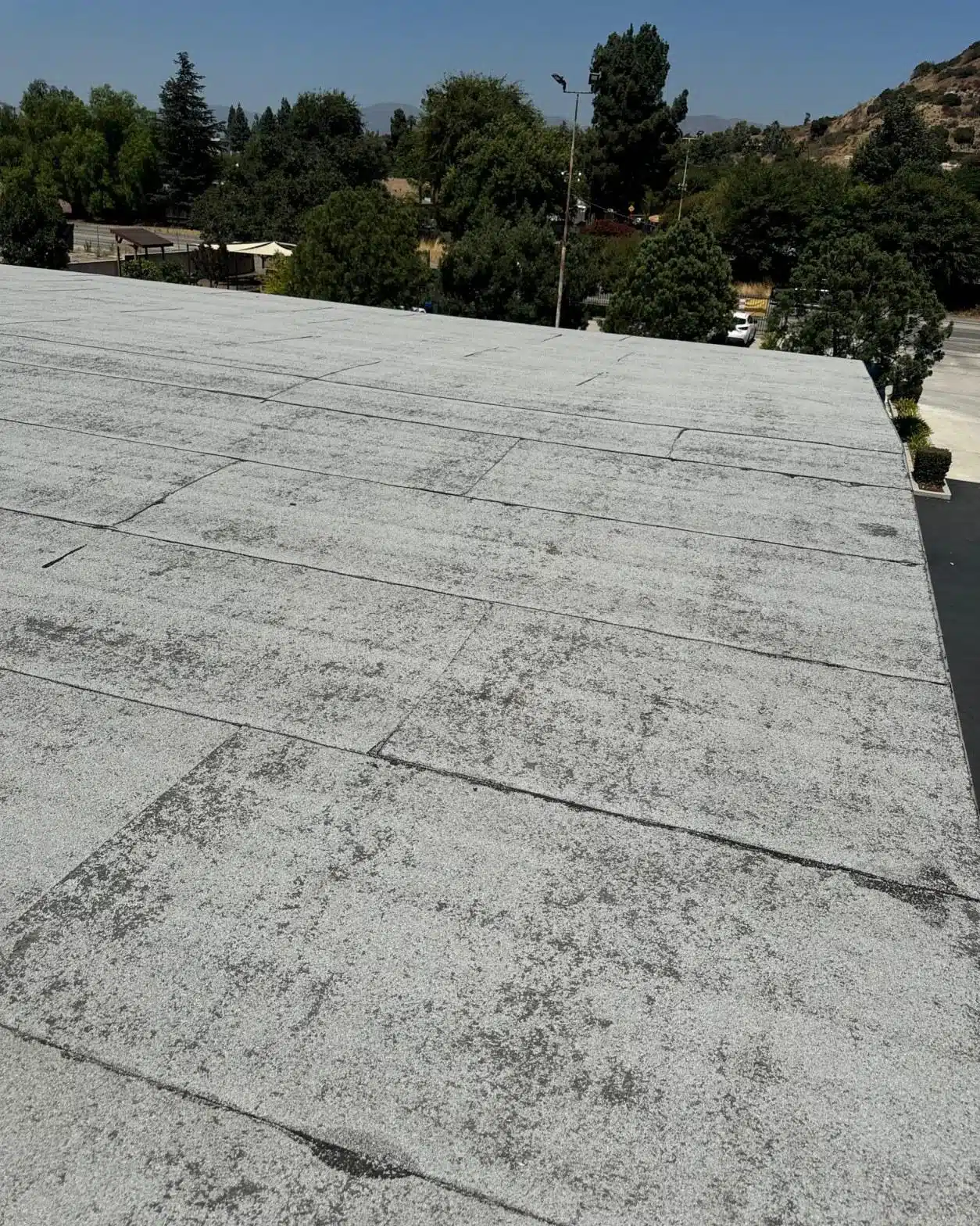
What Did We Find When We Stripped the Old Roof?
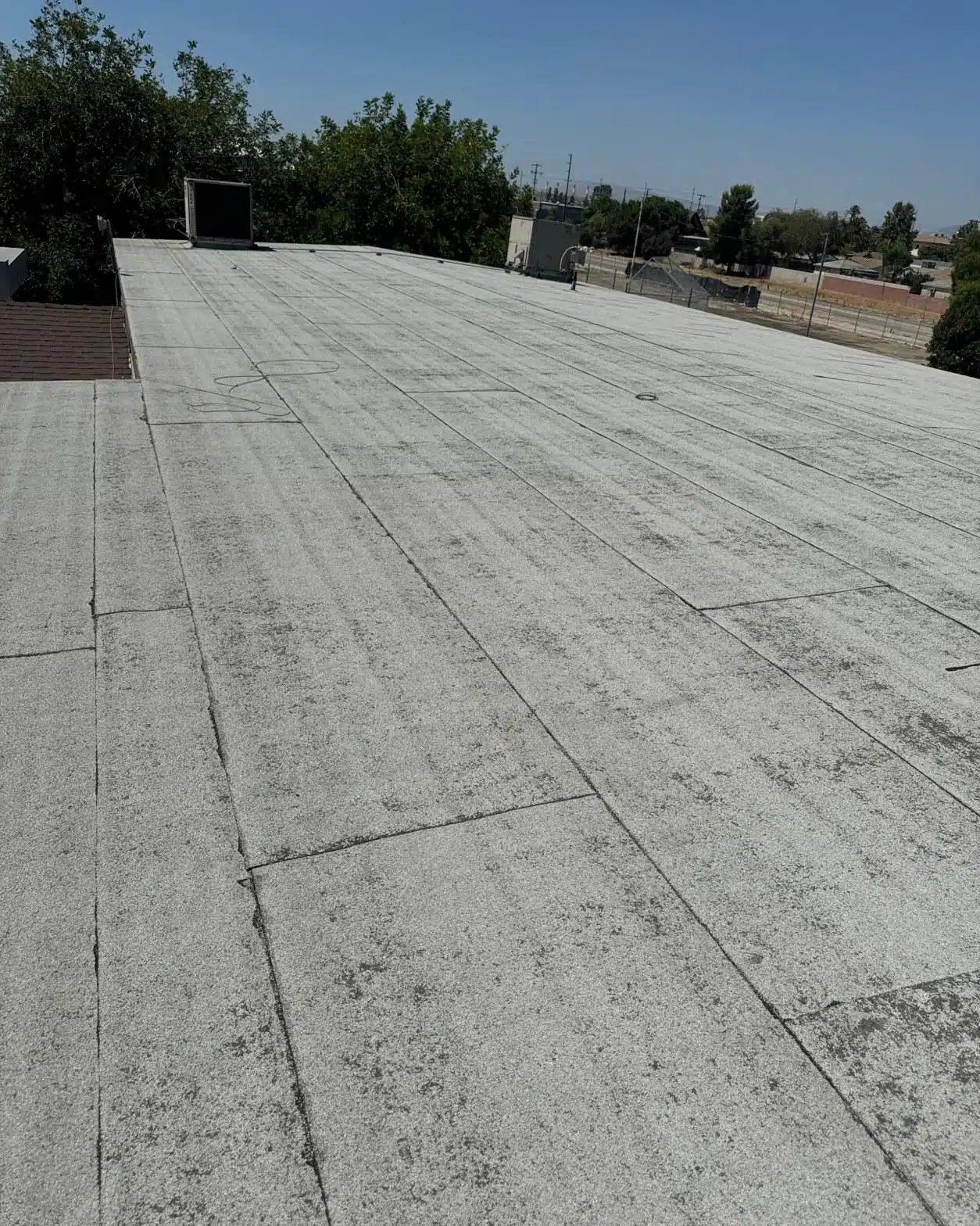
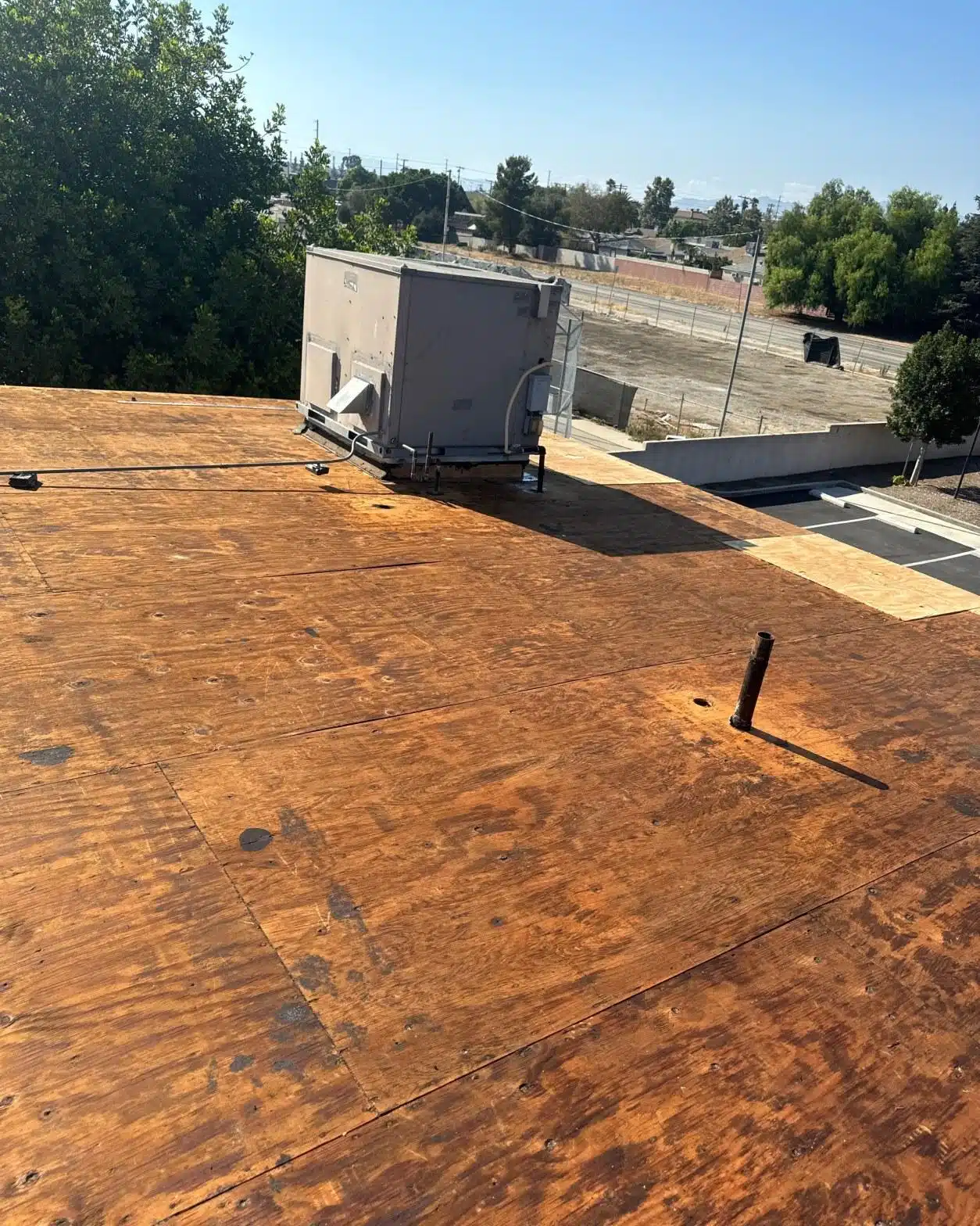
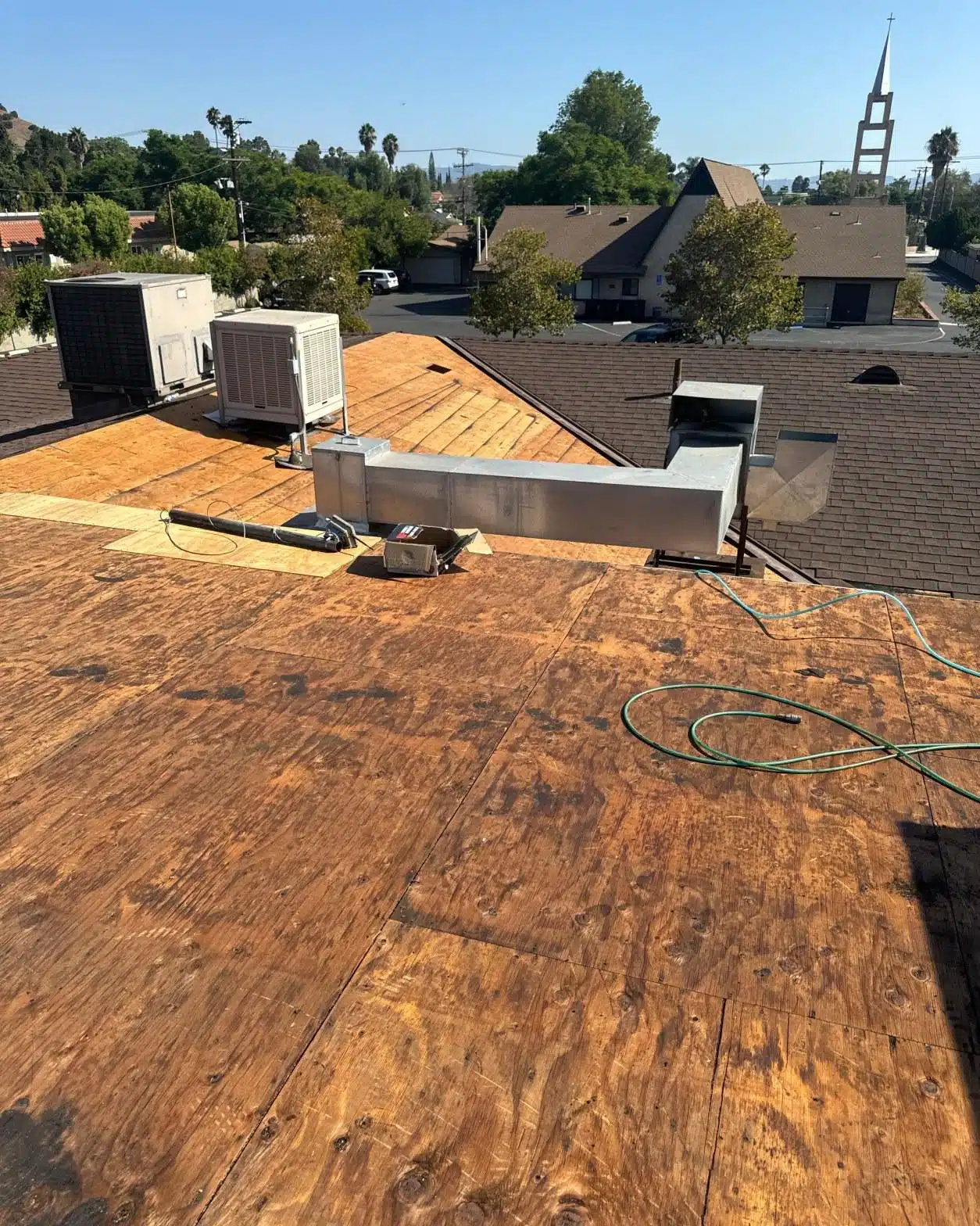
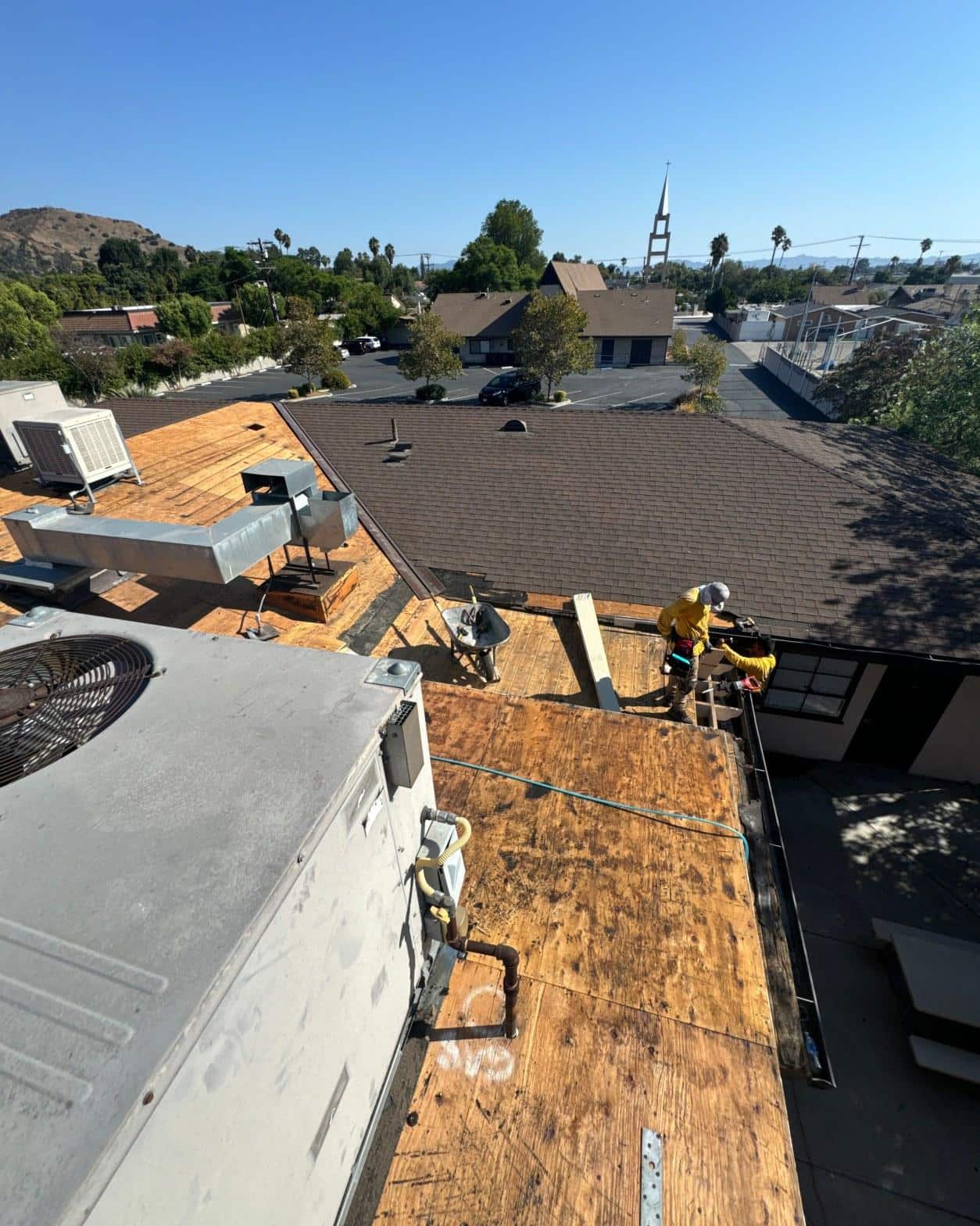
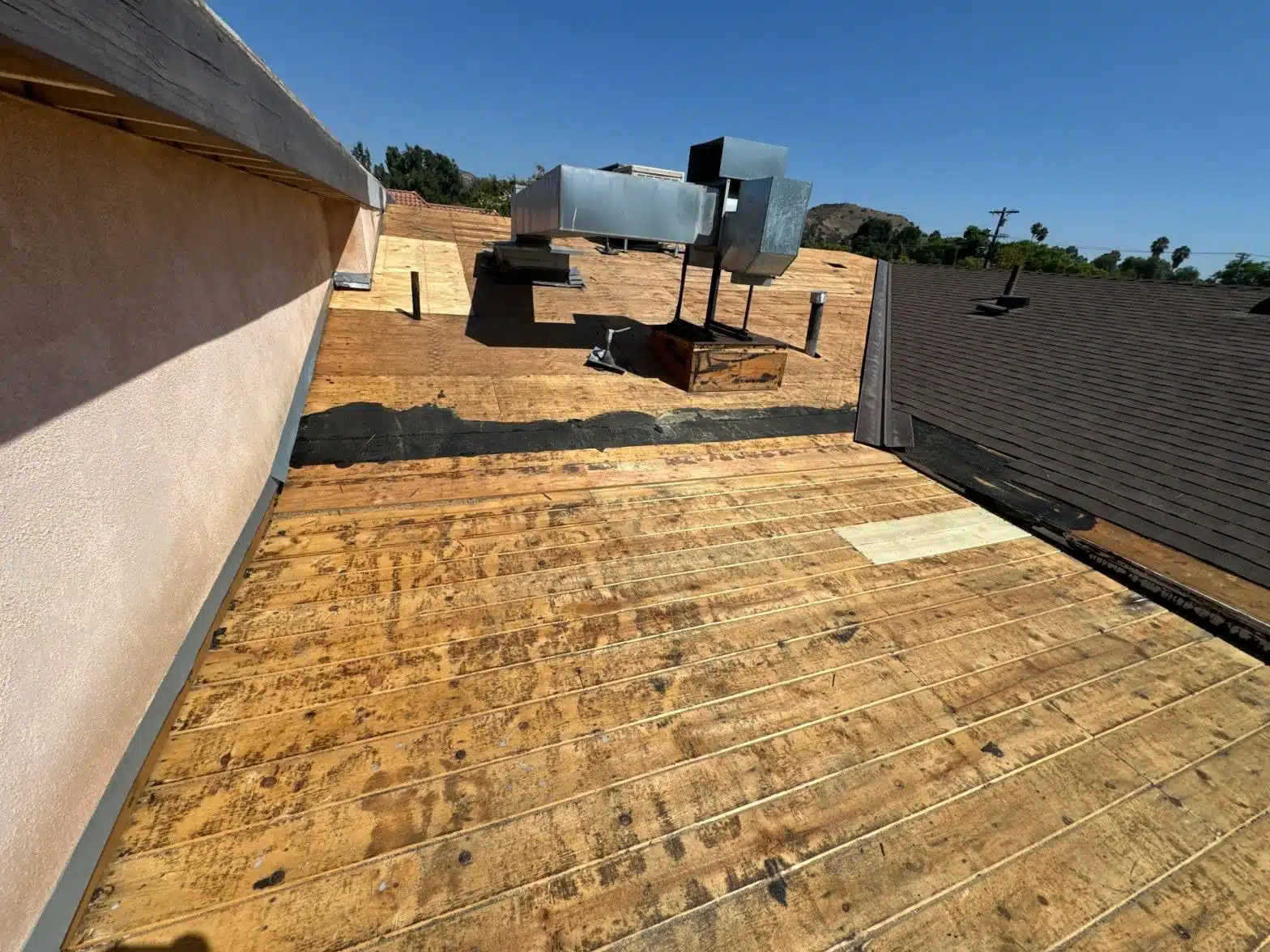
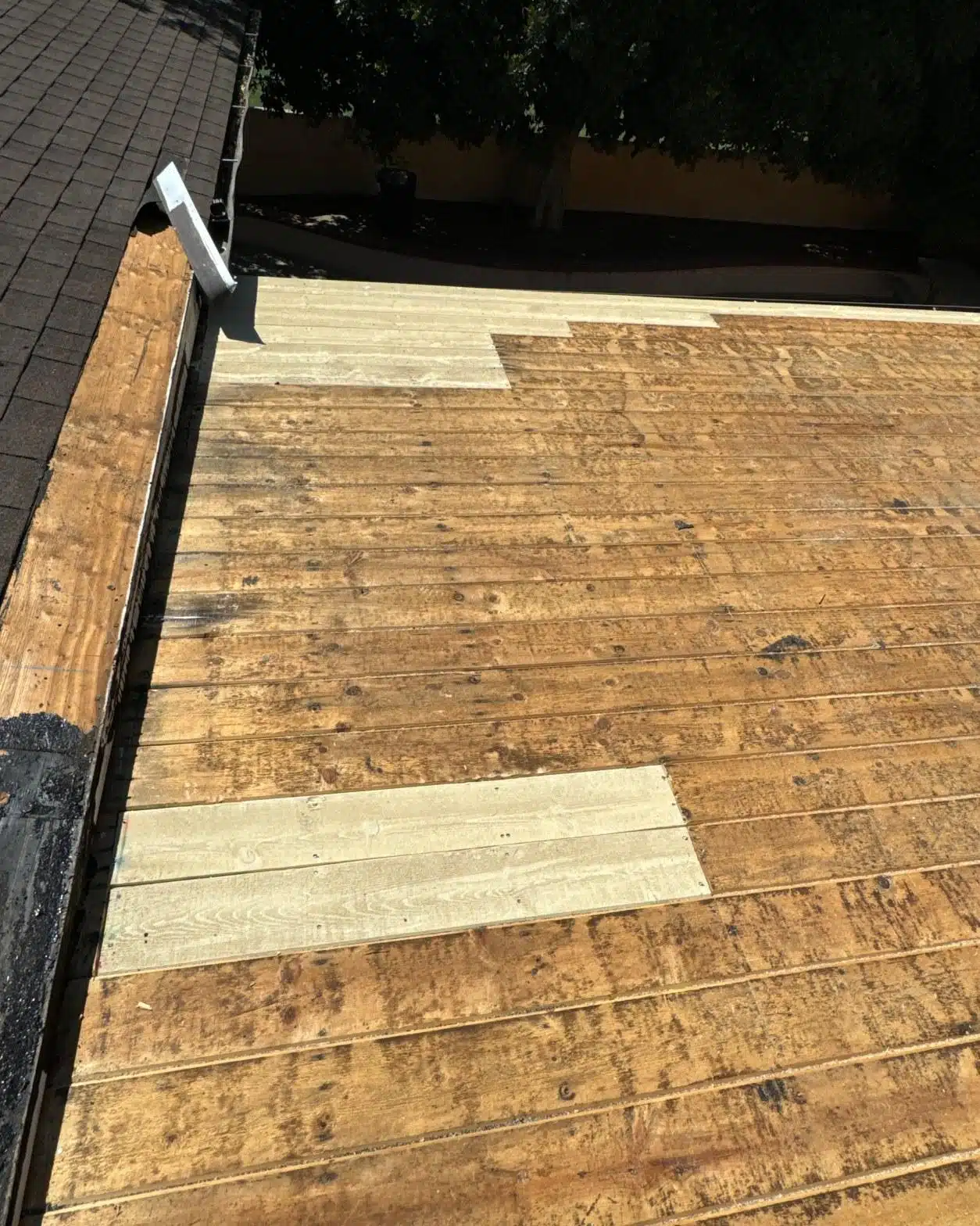
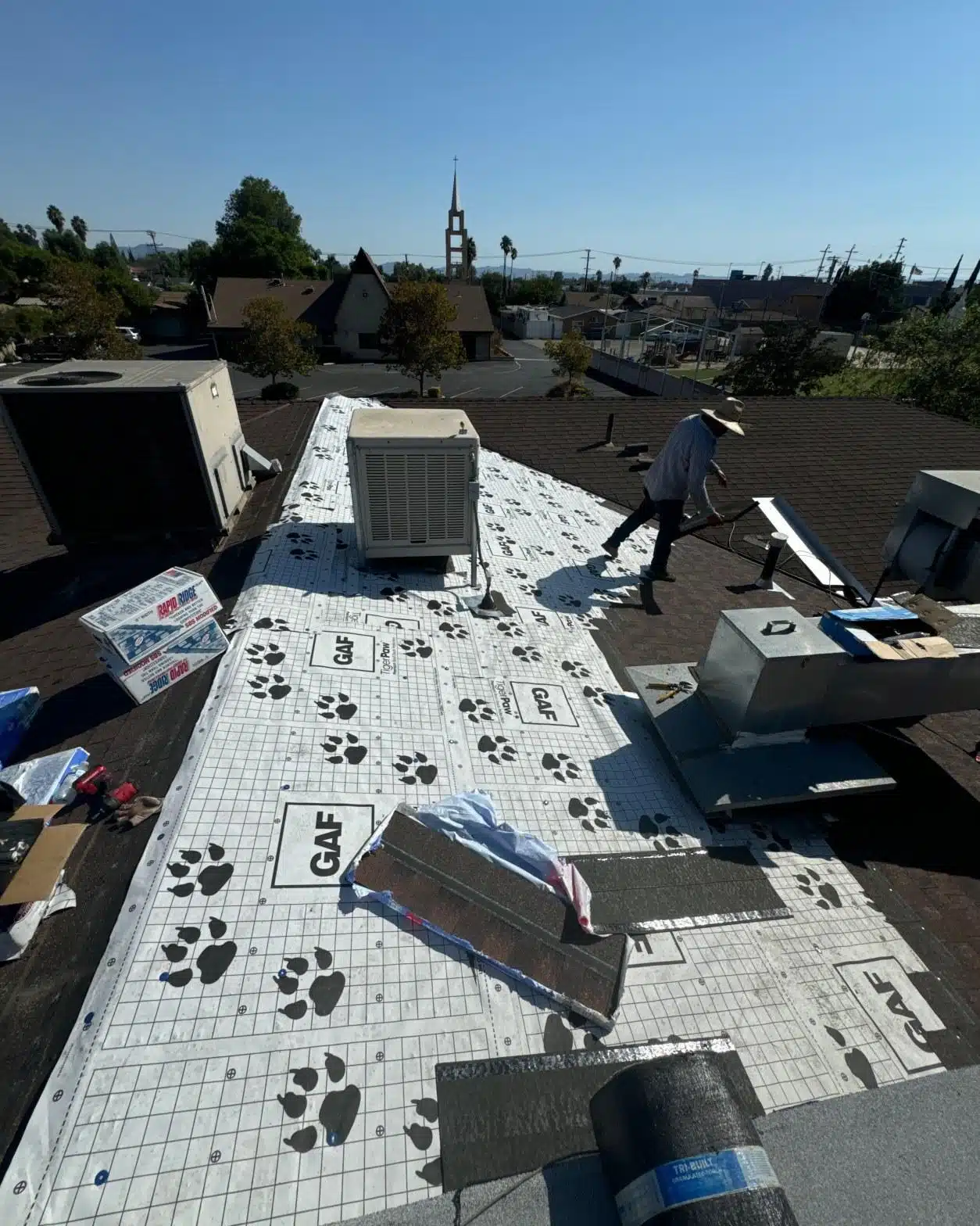
Once the existing membrane came off, the plywood decking showed the water-damage staining and soft spots that are common on flat roofs that have been leaking at the seams for more than one season. Modified bitumen membranes typically carry a serviceable life of 15 to 20 years when properly maintained, but seam failures and ponding water accelerate deterioration significantly. On this roof, sections of decking had absorbed enough moisture that replacement panels were required before the new membrane could be torched down.
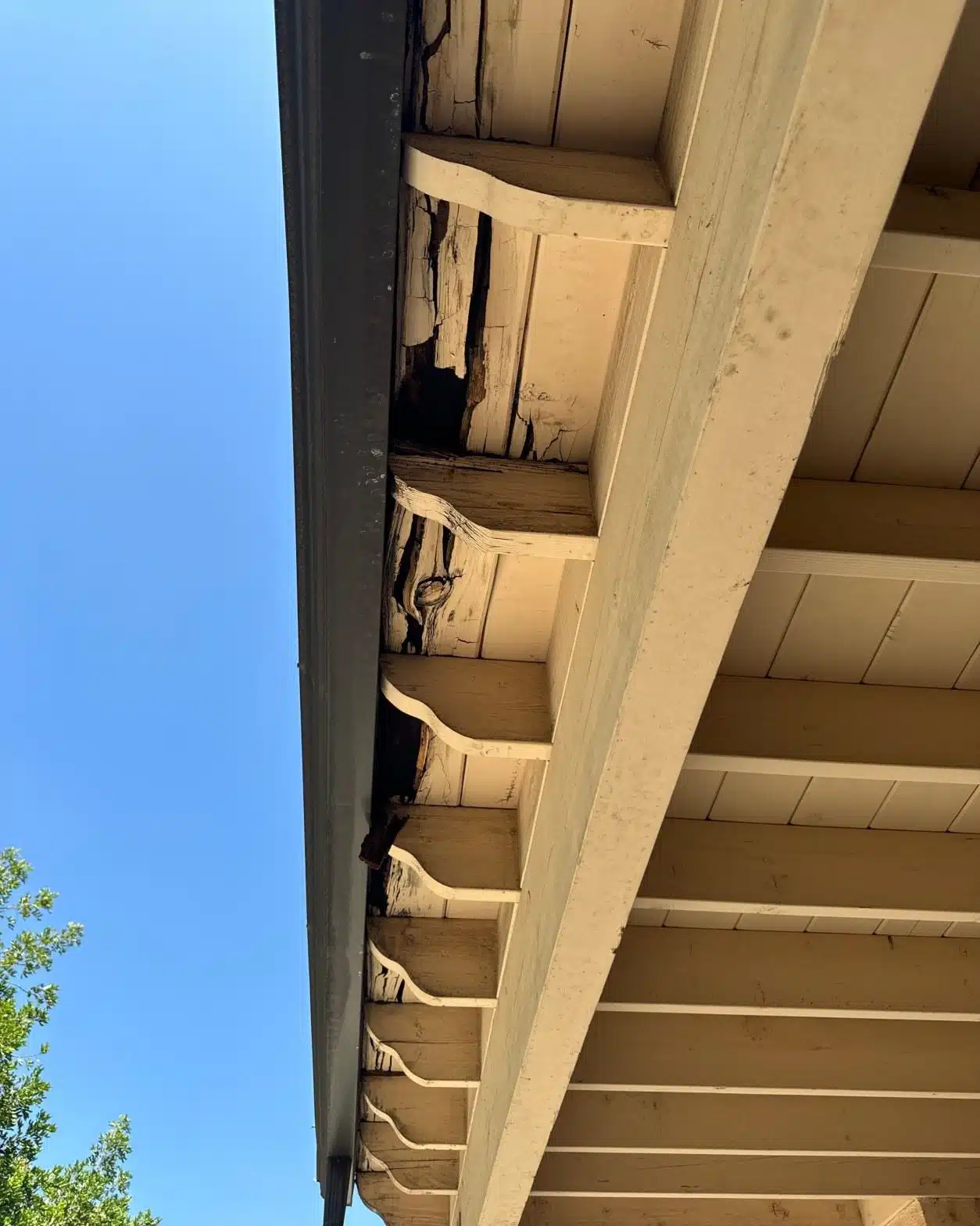
The fascia condition told an equally familiar story.
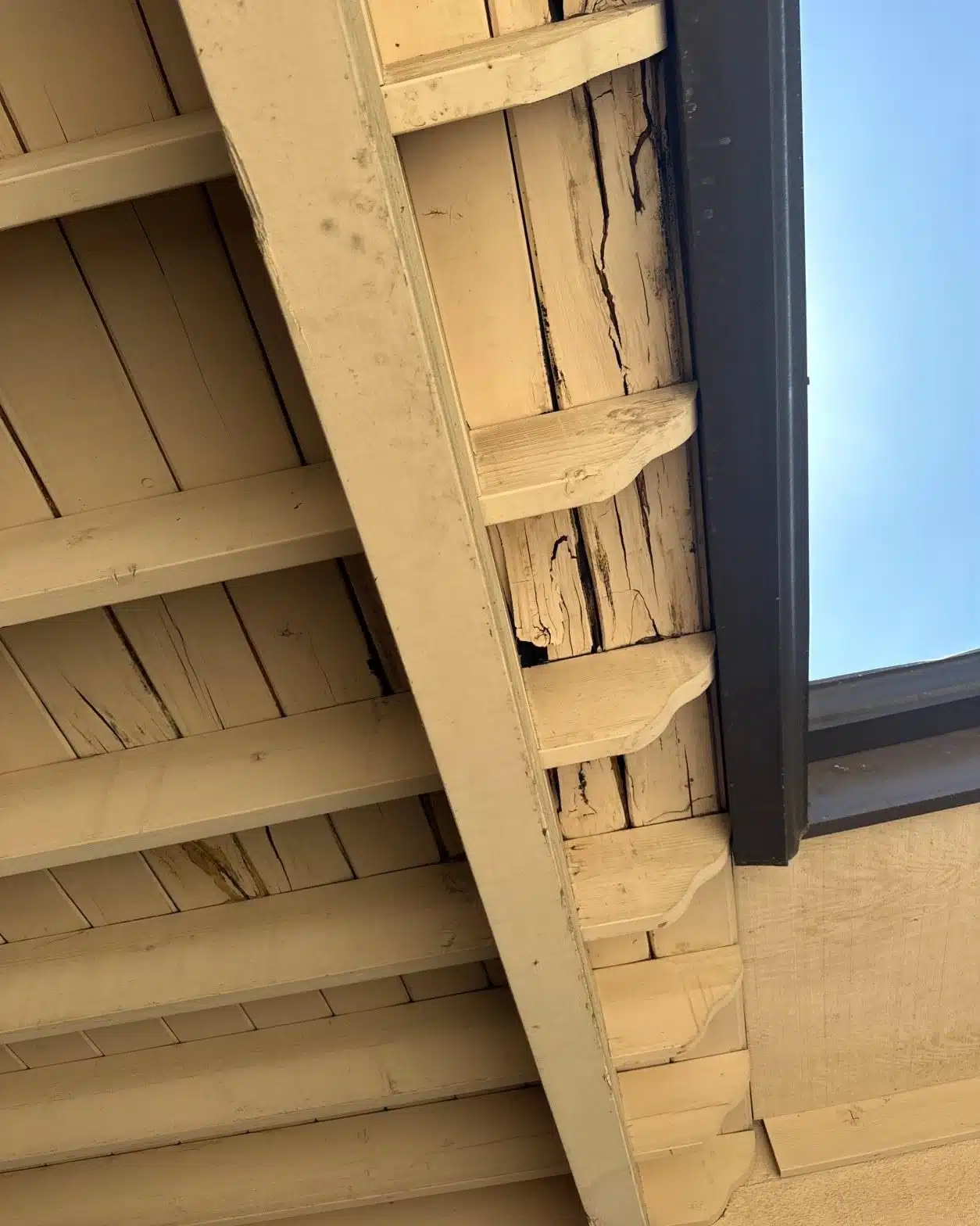
The close-up of the eave shows fascia boards cracked through their full depth, with the wood fiber separating into vertical splits, a pattern caused by years of wet-dry cycling in Southern California’s climate. Los Angeles County averages fewer than 15 inches of rainfall per year, but when winter storms arrive, unprotected wood at roof edges absorbs water quickly and then bakes dry in heat that regularly exceeds 95°F in the inland valleys. Those 3 to 4 failed fascia sections were removed and replaced with fresh dimensional lumber before new drip edge flashing was set.
Our crew also documented at least 2 separate areas of delaminated decking panels during the inspection walk, both located near the existing HVAC curbs where condensation drainage had been pooling unchecked for multiple seasons.
How Was the New Modified Bitumen Membrane Installed?
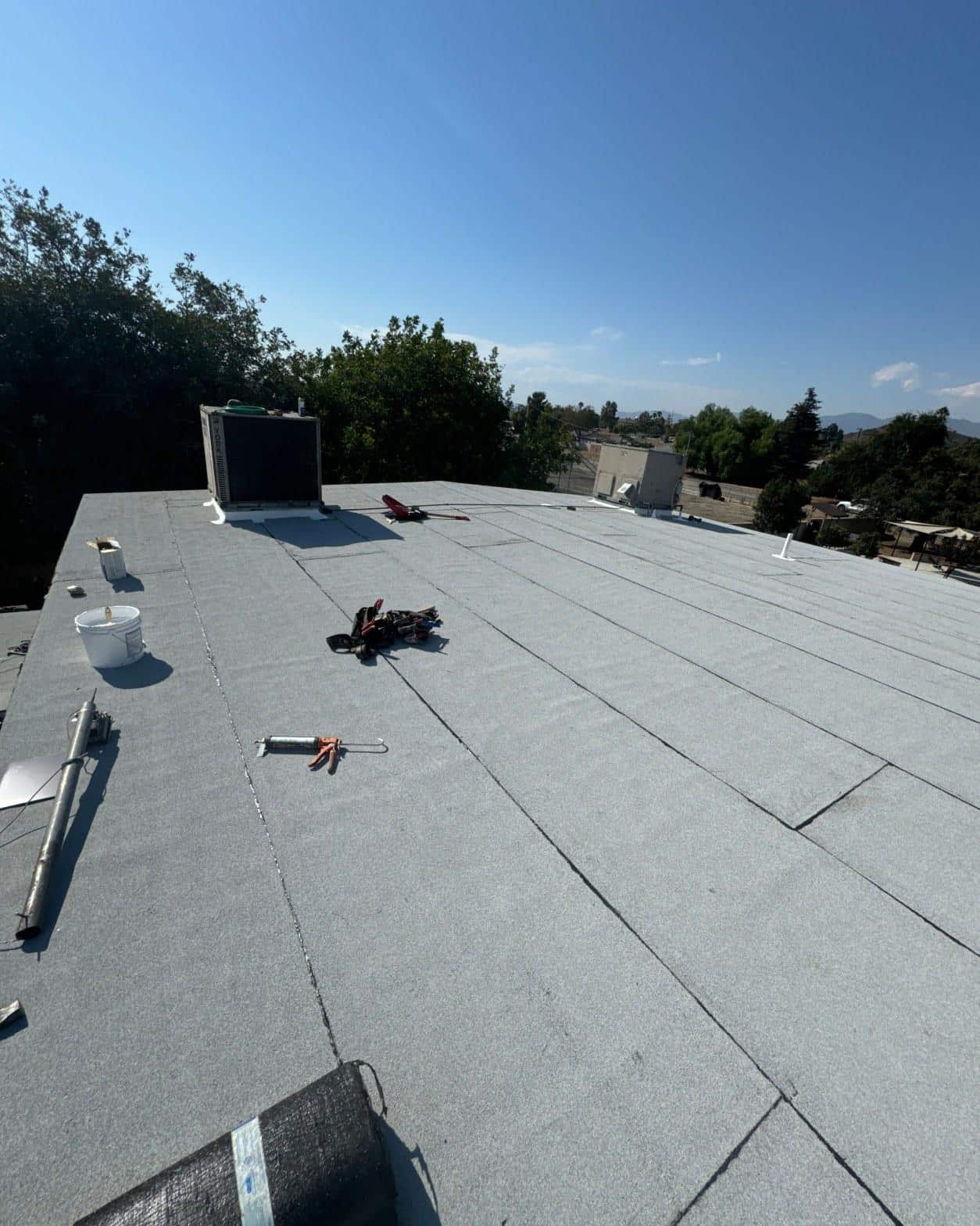
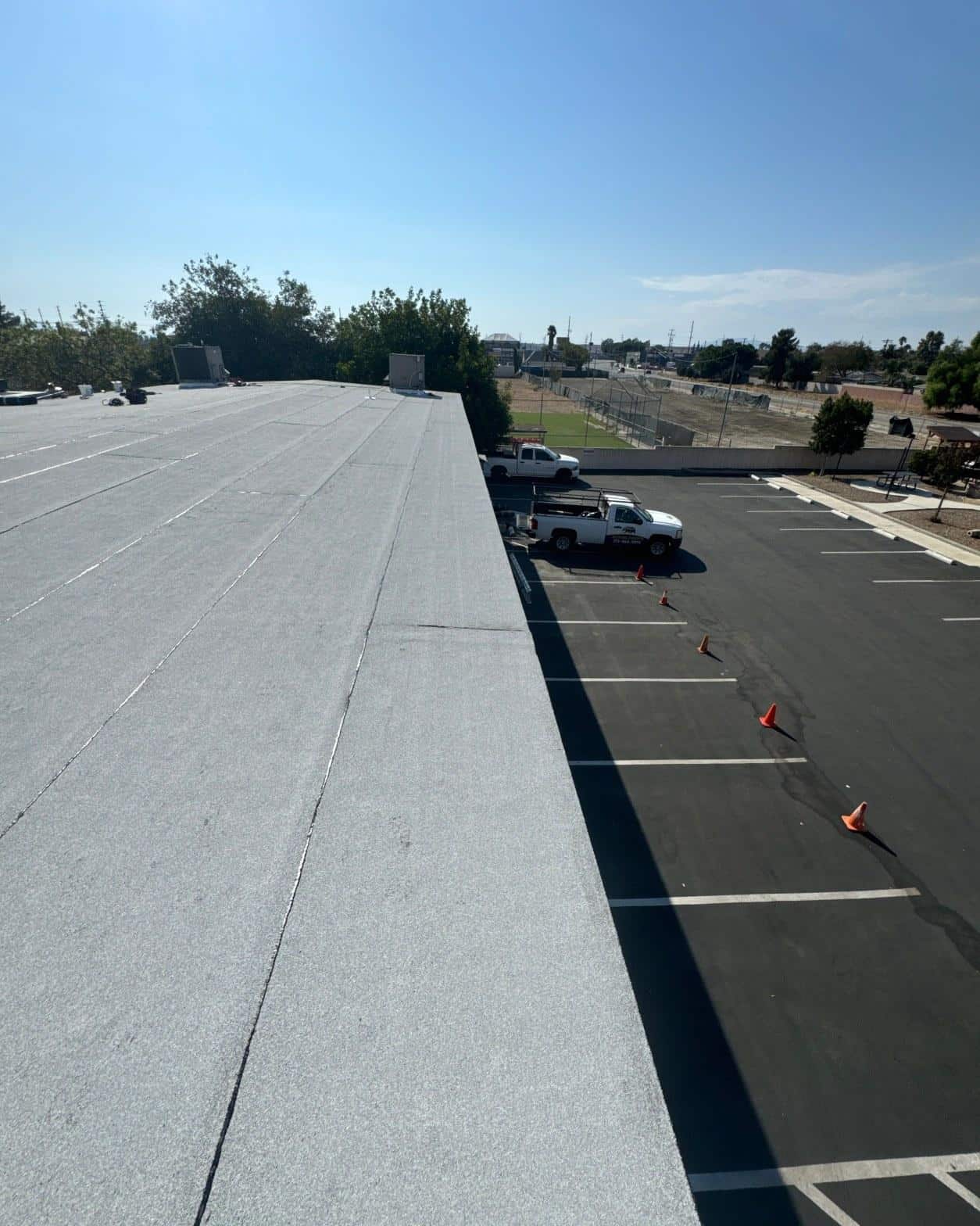
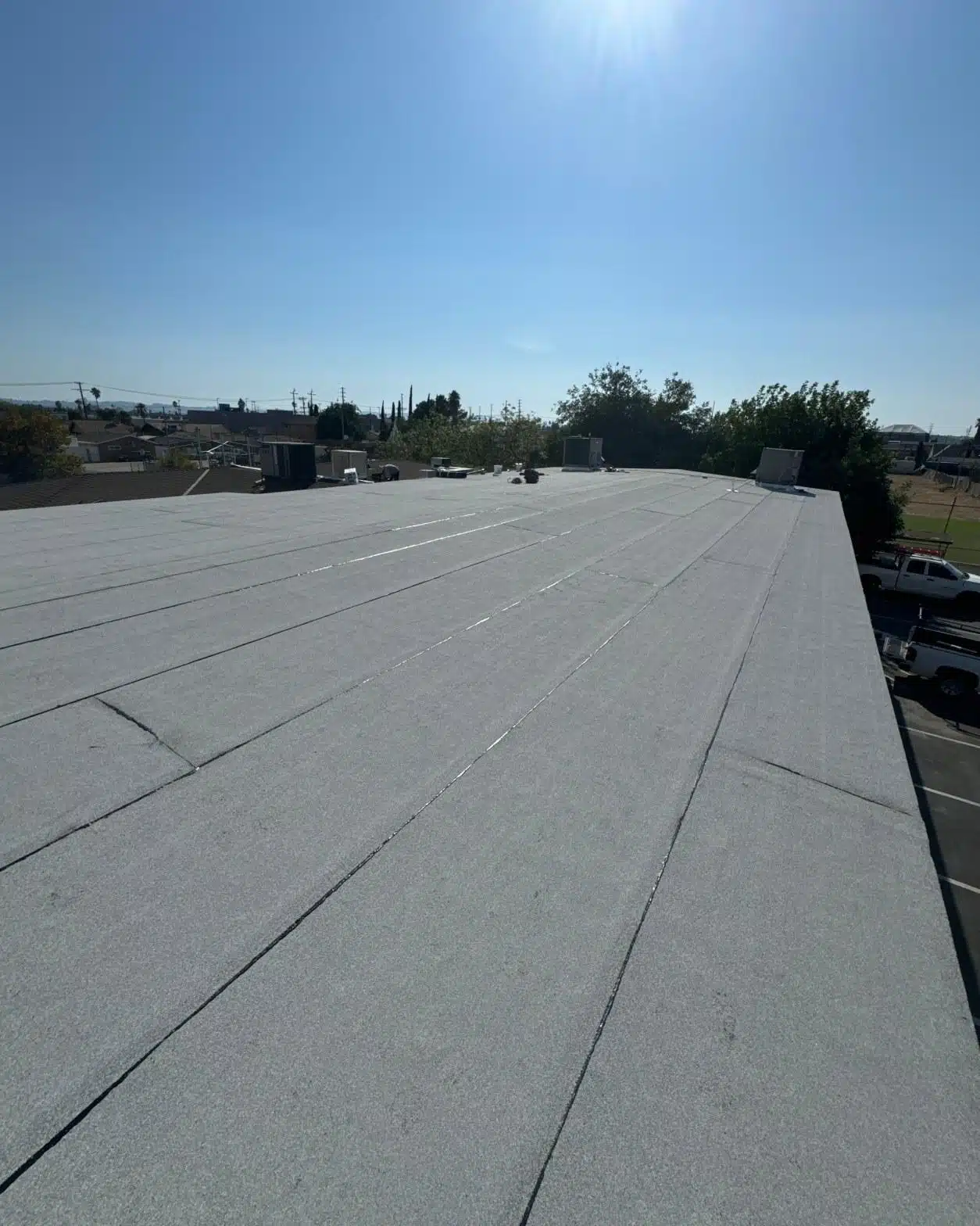
The replacement system is a torch-applied modified bitumen assembly with a white granule cap sheet, which reflects solar energy and reduces rooftop surface temperatures by as much as 50°F compared to an uncoated black membrane. That thermal performance is directly relevant under California’s Title 24 building energy standards, which set cool-roof reflectance requirements for low-slope commercial roofs. A white granule cap sheet satisfies those requirements without an added coating layer.
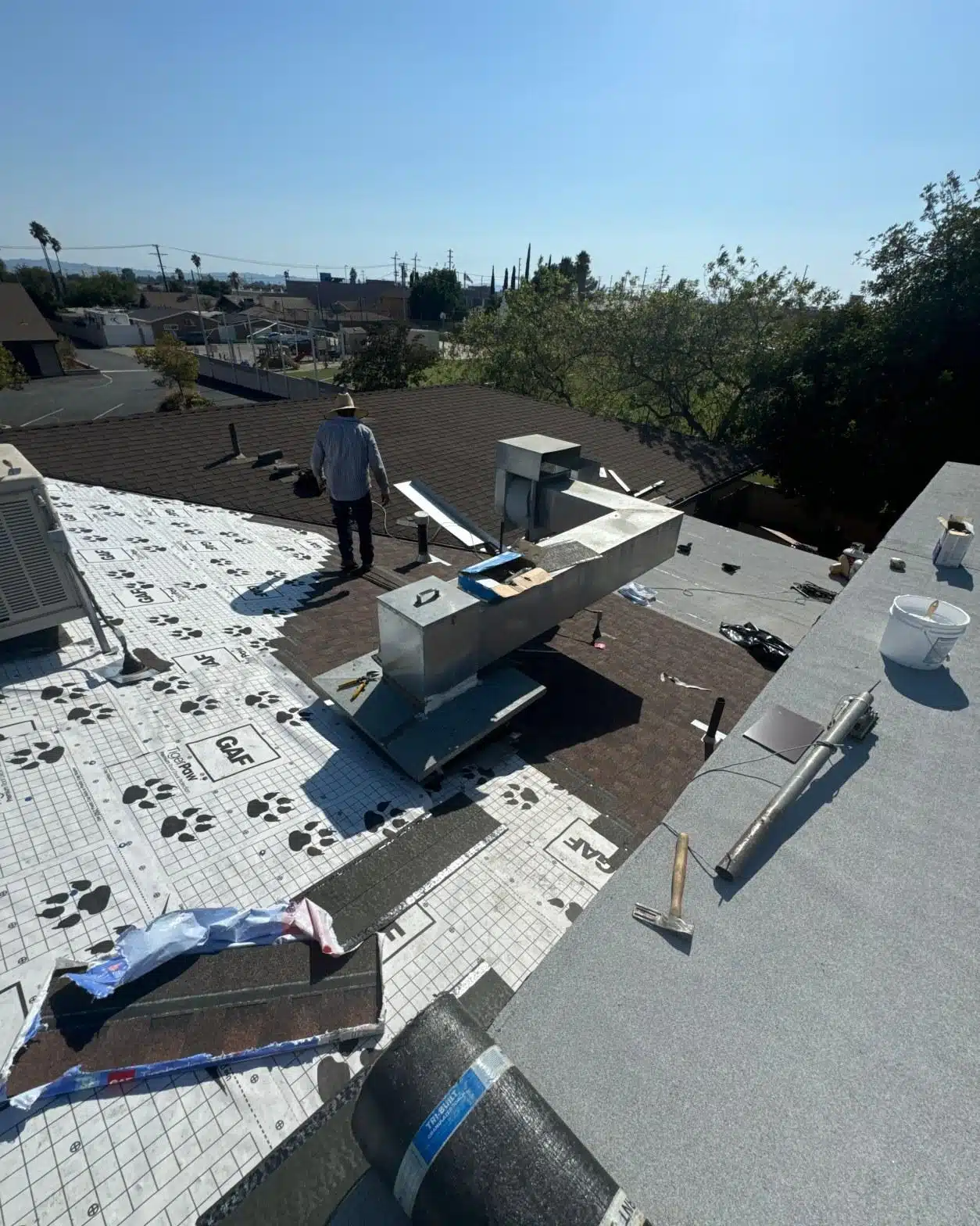
The installation sequence on a job like this runs in 3 distinct phases: decking repair and fastening, base sheet application, and cap sheet torch-down with fully heat-welded laps. Every seam on a torched membrane is fused rather than adhered with cold adhesive, which is why properly installed modified bitumen can outperform older built-up roofing systems that rely on cold-process layers prone to delamination.
Across our commercial flat roof projects in the region, we consistently find that roofs with south- and west-facing exposures show granule wear concentrated along the field of the membrane rather than at the seams, which is the opposite of what you see on shaded or north-facing sections. That wear pattern guided our decision to specify a heavyweight granule cap sheet here rather than a smooth-surface cap with a field coating.
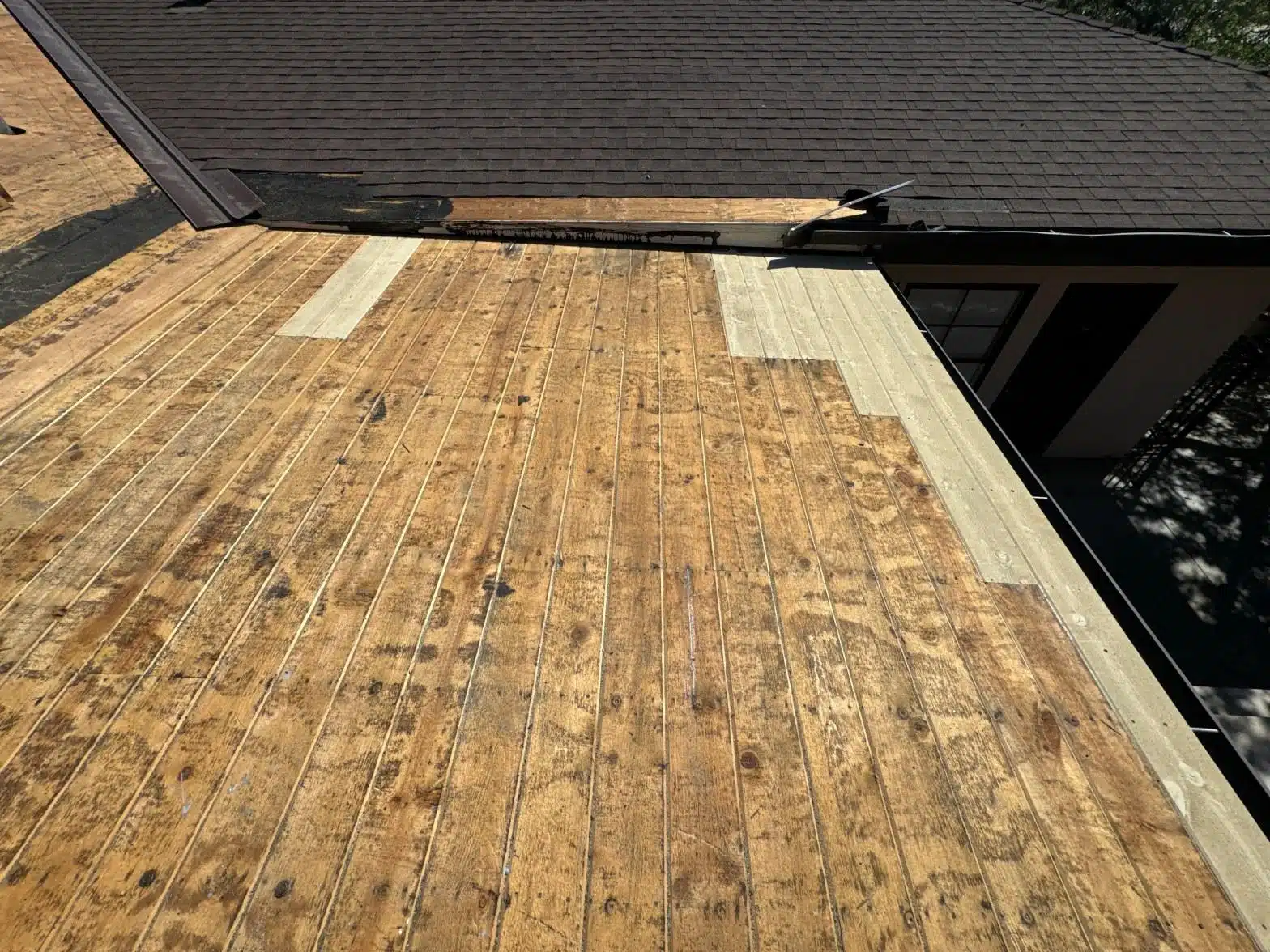
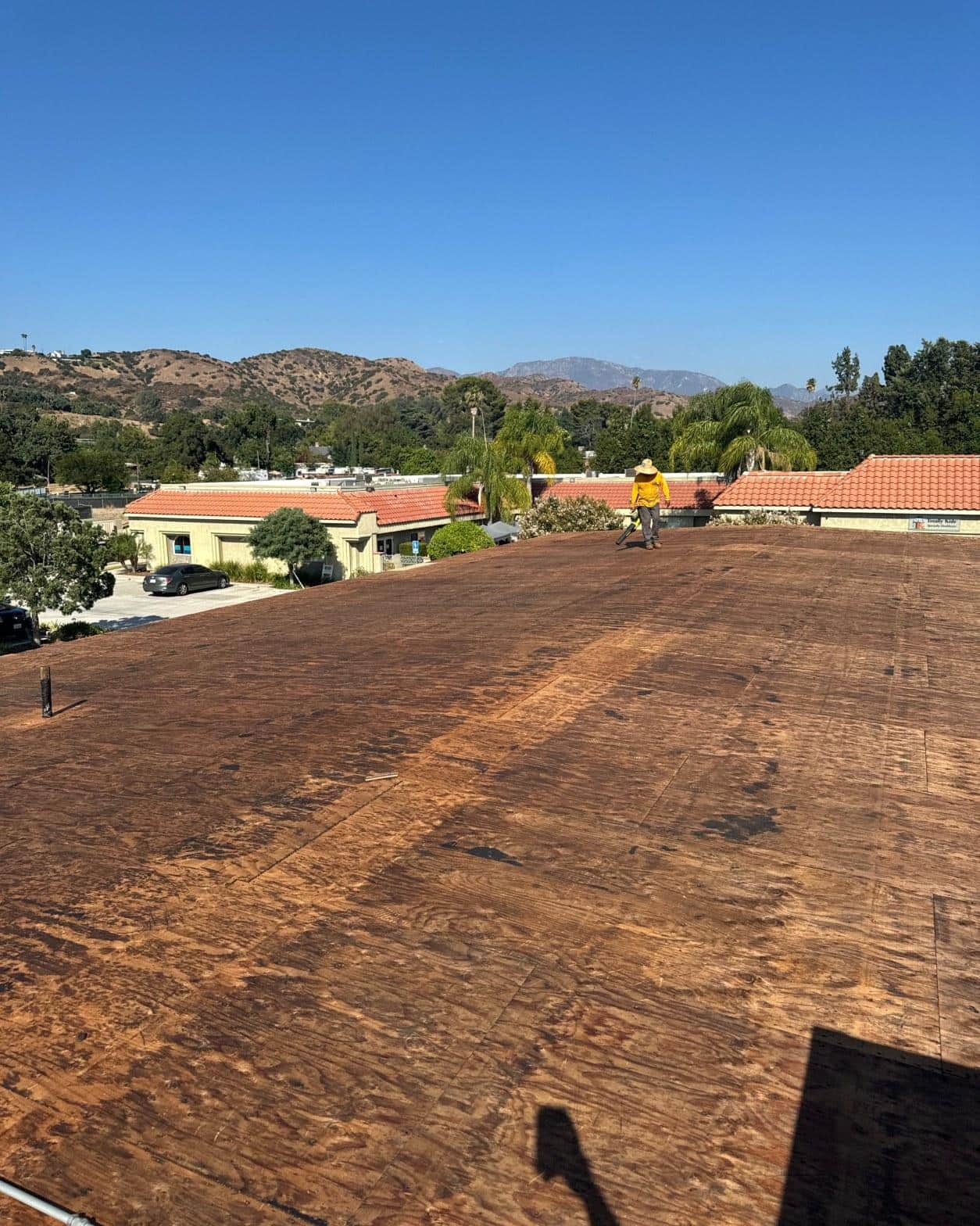
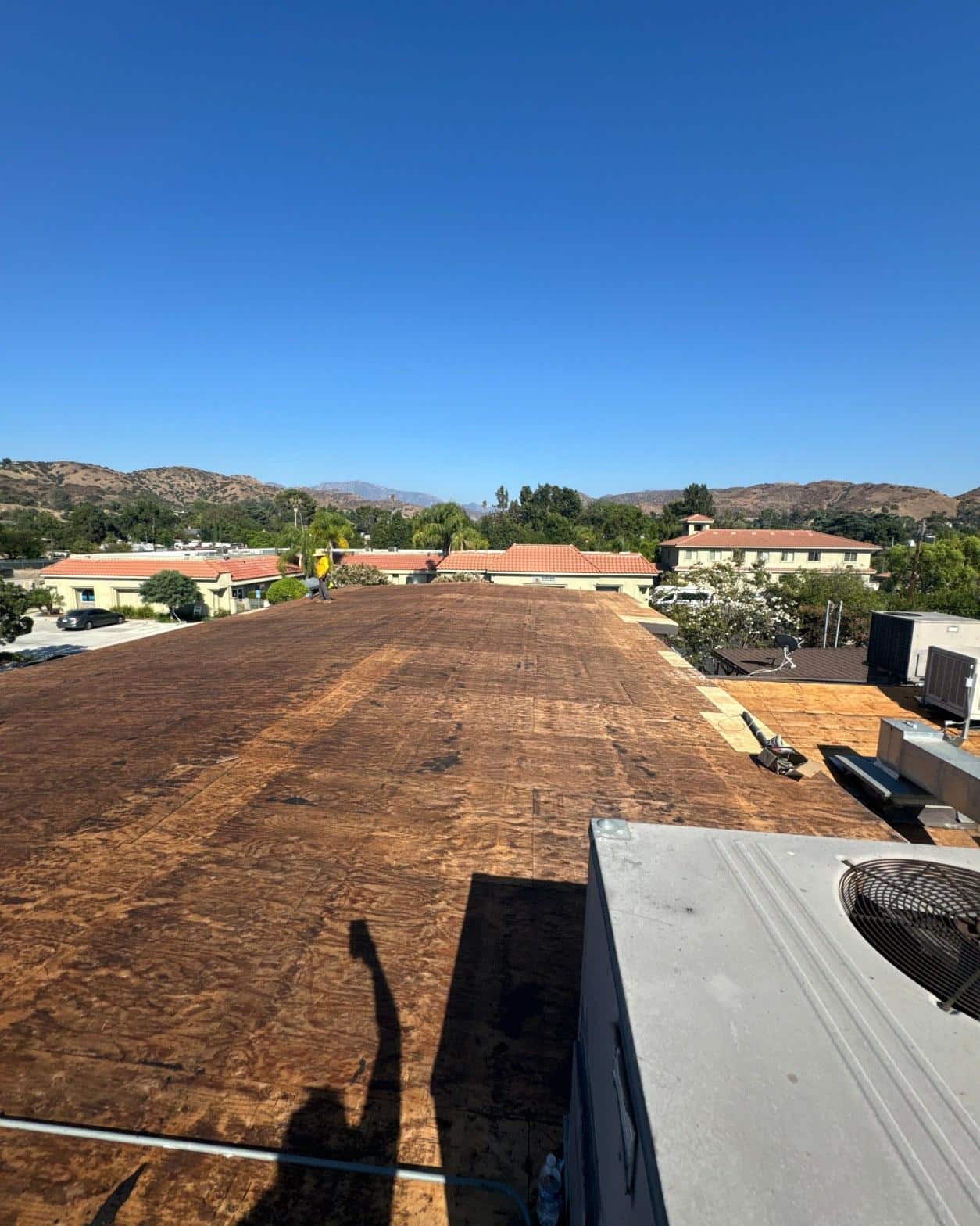
The photo of the stripped decking mid-project shows the plywood panels still in place across the larger field of the roof, with the old membrane fully removed and replacement panels patched into the areas where the old wood had softened. All new panels were fastened to current code spacing before any underlayment went down.
How Was the Rooftop HVAC Equipment Handled?
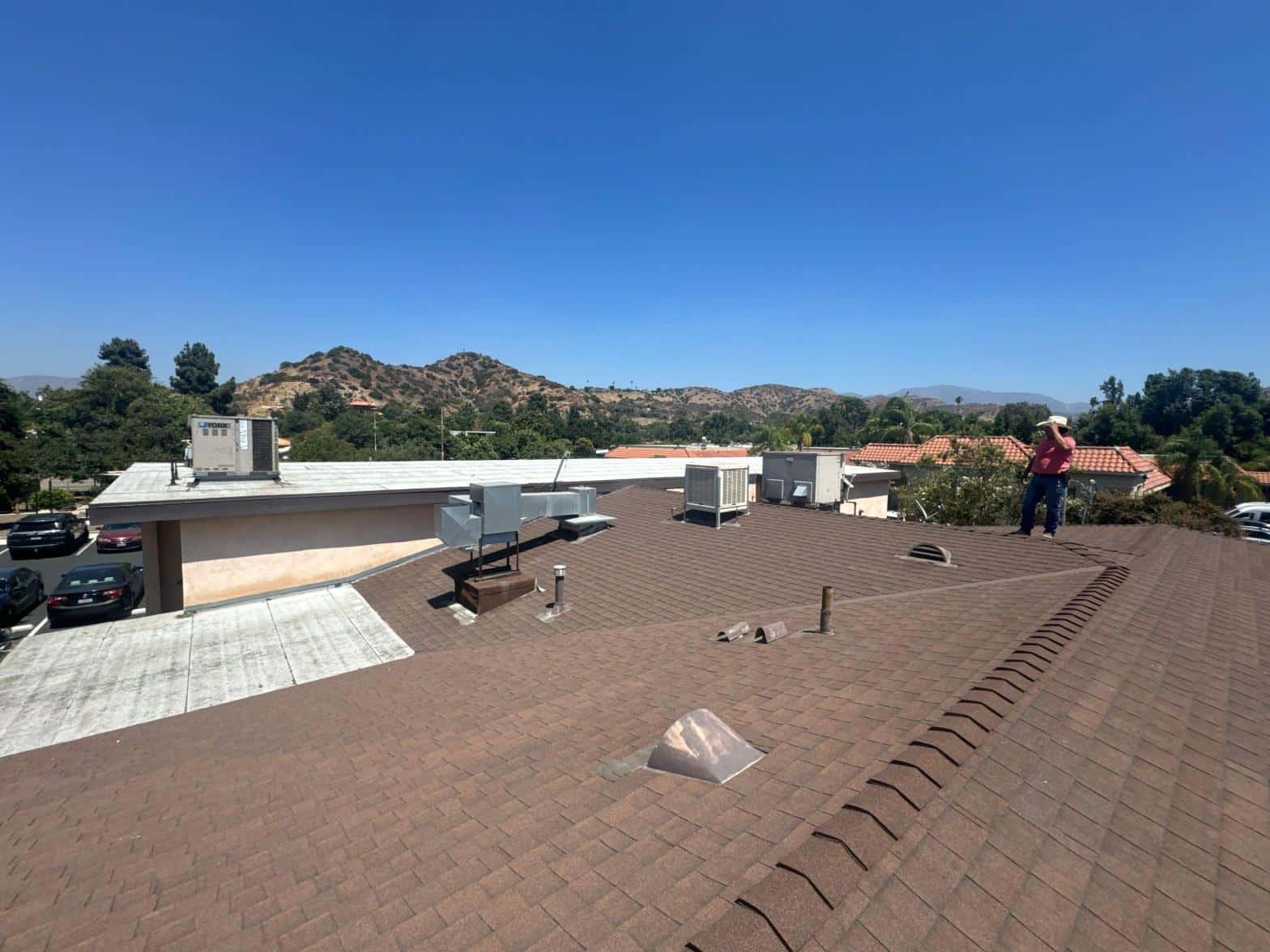
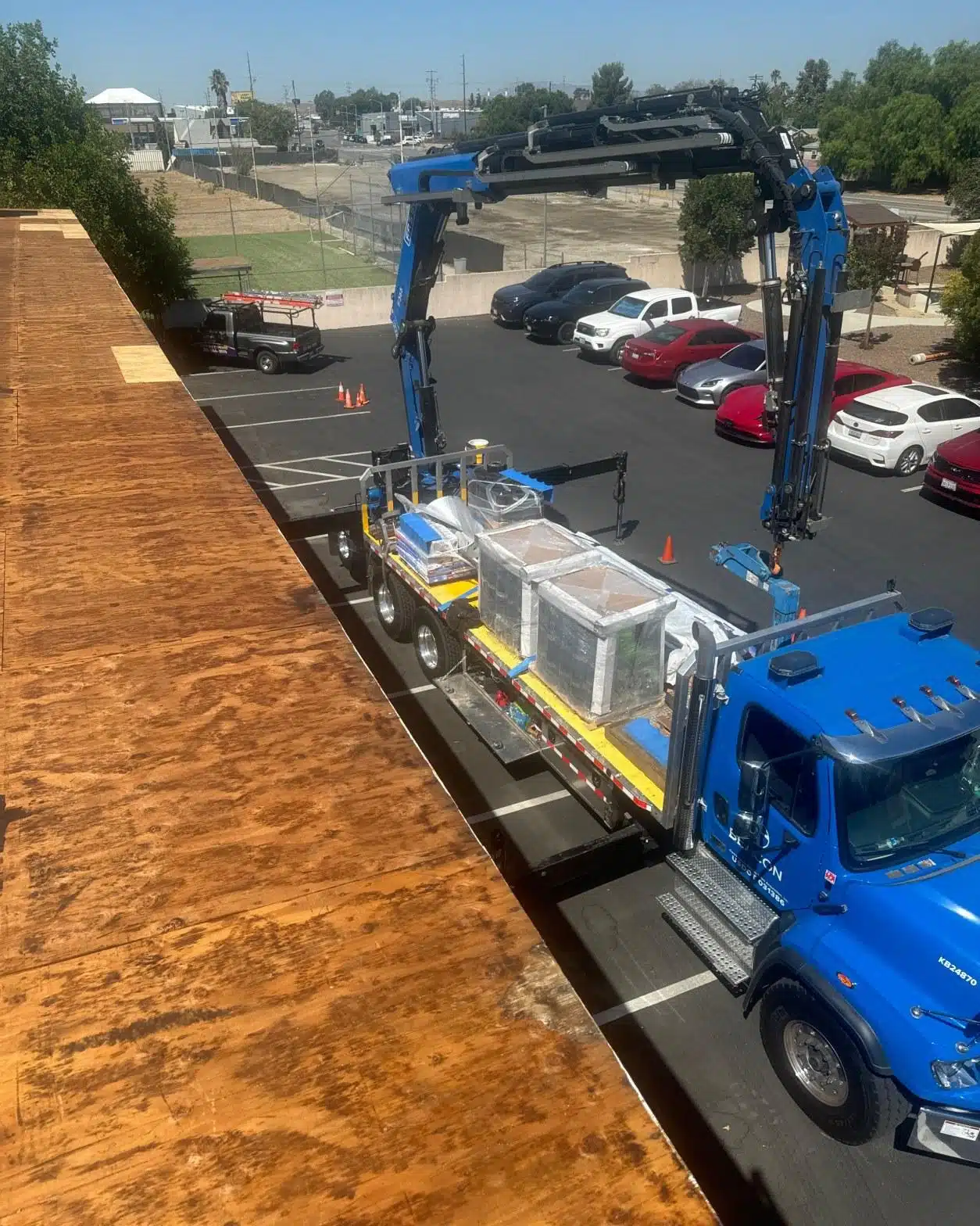
Because the building had multiple rooftop HVAC units that needed to be cleared from the work area during the tear-off and membrane installation, the project required a crane lift. The featured photo at the top of this article shows the articulating crane positioning one of the packaged units while the stripped deck below is fully prepared and safety cones mark the lift zone perimeter.
Crane-assisted equipment handling adds a half-day to a project of this scale but eliminates the risk of membrane damage from dragging heavy units across a freshly torched surface. It also allows the crew to fully flash and seal the HVAC curbs, which are among the most common leak entry points on any flat commercial roof, before the units are set back down.
Ready to Replace Your Commercial Flat Roof?
If your building’s membrane is more than 15 years old, showing seam ridges, or leaking near the equipment curbs, a full tear-off is almost always the more cost-effective path compared to layering new material over a compromised base. Get a written scope and quote before any work begins. Call Roof Repair & Construction Inc. or submit a project inquiry online. We serve commercial properties throughout Los Angeles County and are Licensed by the California Contractors State License Board (CSLB).
Gallery
Explore our full range of Roof Repair services across Southern California.
Frequently Asked Questions
How long does a commercial flat roof tear-off and replacement usually take?
A commercial flat roof tear-off and modified bitumen replacement typically takes 3 to 7 working days depending on roof size, the extent of decking repairs needed, and whether rooftop equipment requires crane relocation. Projects with significant wood damage or multiple HVAC curbs to reflash run toward the longer end of that range.
How do I know if my flat roof needs a full tear-off or just a repair?
If your existing membrane has widespread seam failures, the decking beneath has absorbed moisture and softened, or the membrane is more than 15 to 20 years old, a full tear-off is generally the right call. Patching over a compromised base shortens the life of the new material and can void manufacturer coverage on the new membrane.
What is a modified bitumen cap sheet and why does it have white granules on it?
Modified bitumen is a polymer-reinforced asphalt membrane that is torch-applied to create fully fused, watertight seams. The white granules on the cap sheet surface reflect solar radiation and can lower rooftop surface temperatures by up to 50°F, which reduces building cooling loads. White granule cap sheets also satisfy California's Title 24 cool-roof reflectance requirements for low-slope commercial roofs.
Does a rooftop HVAC unit have to be moved during a flat roof replacement?
Yes, in most cases the units need to be temporarily lifted so the membrane can be fully replaced beneath them and the equipment curbs can be properly flashed. A crane is the safest method for heavy packaged units, and the lift typically adds about half a day to the overall project schedule.
How much does rotted fascia repair add to a commercial reroof project?
Fascia replacement cost depends on the linear footage affected and the lumber dimensions required. On a mid-size commercial building, replacing 3 to 6 failed fascia sections typically adds one to two days of carpentry labor before the roofing crew can set drip edge and begin the membrane. Skipping it is not advisable because failed fascia allows water to wick directly into the wall assembly behind the roof edge.
Does a new commercial flat roof qualify for any California energy incentives?
Cool-roof systems that meet California Energy Commission reflectance thresholds may qualify for utility rebates through programs tied to California's Title 24 building energy standards. Federal tax incentives for commercial building energy improvements have also been expanded as of the 2022 Inflation Reduction Act, so it is worth consulting a tax advisor about Section 179D deductions when replacing a roof with a qualifying cool-roof assembly.