Affordable Roof Repair in Los Angeles, CA: 2026 Pricing Guide for Roof Flashing
Roof flashing repairs are one of the most common — and most overlooked — sources of leaks in Los Angeles homes. This 2026 pricing guide covers what flashing work typically costs in the LA market, what drives the price up or down, and when to call a licensed roofer.
Why Roof Flashing Repairs Are Urgent in Los Angeles, CA Right Now
Santa Ana wind events, which regularly push gusts past 60 mph across the Los Angeles basin each fall, are the single biggest trigger for flashing failures on Southern California roofs. When flashing lifts or separates, even a light winter rain — Los Angeles averages around 15 inches of annual rainfall according to NOAA’s Los Angeles forecast office — can drive water straight into the roof deck and framing below.
As of 2026, many Los Angeles homeowners are also dealing with aging roofs that were installed during the building boom of the late 1990s and early 2000s. A roof that is 20 to 25 years old has flashing that has gone through hundreds of heat cycles. Daytime summer temperatures on a dark roof surface in the San Fernando Valley can exceed 150°F, while winter nights drop into the 40s — that expansion and contraction breaks sealant and loosens fasteners over time.
Daytime summer temperatures on a dark roof surface in the San Fernando Valley can exceed 150°F, while winter nights drop into the 40s — that expansion and contraction breaks sealant and loosens fasteners over time.
Finding affordable roof repair before a small flashing gap becomes a rotted deck or a mold problem is the smartest financial move a homeowner can make. For a broader look at general roof leak repair costs in California, see our cost to repair a leaking roof in California guide. This article goes deeper on flashing specifically — the metal or composite strips that seal every roof penetration, edge, and transition on your home.
What Is Roof Flashing and Why Does It Fail?
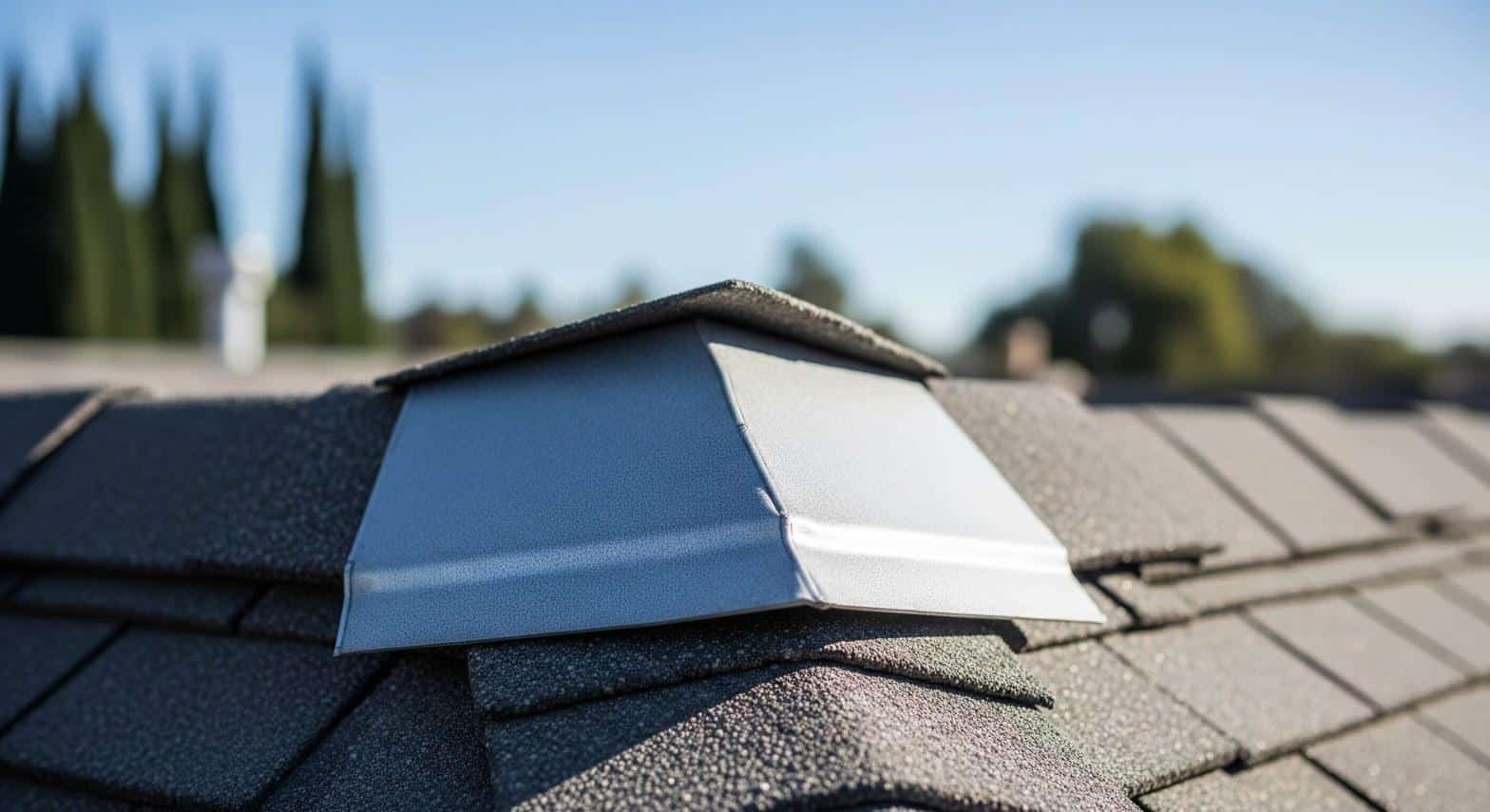
Roof flashing is thin metal or composite material — most commonly galvanized steel, aluminum, or lead — installed wherever the roof surface meets a vertical element like a chimney, skylight, vent pipe, dormer, or wall. It channels water away from those joints and into the drainage system. Without intact flashing, those joints are open pathways for water.
In Los Angeles, CA, the most common flashing materials found on residential roofs are:
- Galvanized steel: Durable and widely used on asphalt shingle roofs across neighborhoods like Inglewood and Lawndale. Can rust after 15 to 20 years if the zinc coating wears through.
- Aluminum: Lightweight and corrosion-resistant, common on newer construction. Reacts with concrete and mortar, so it needs a protective coating near masonry.
- Lead: Flexible and long-lasting, often used around chimney bases on older clay or concrete tile roofs common in Silver Lake and Los Feliz. California has restricted lead use in new installations since the early 2000s.
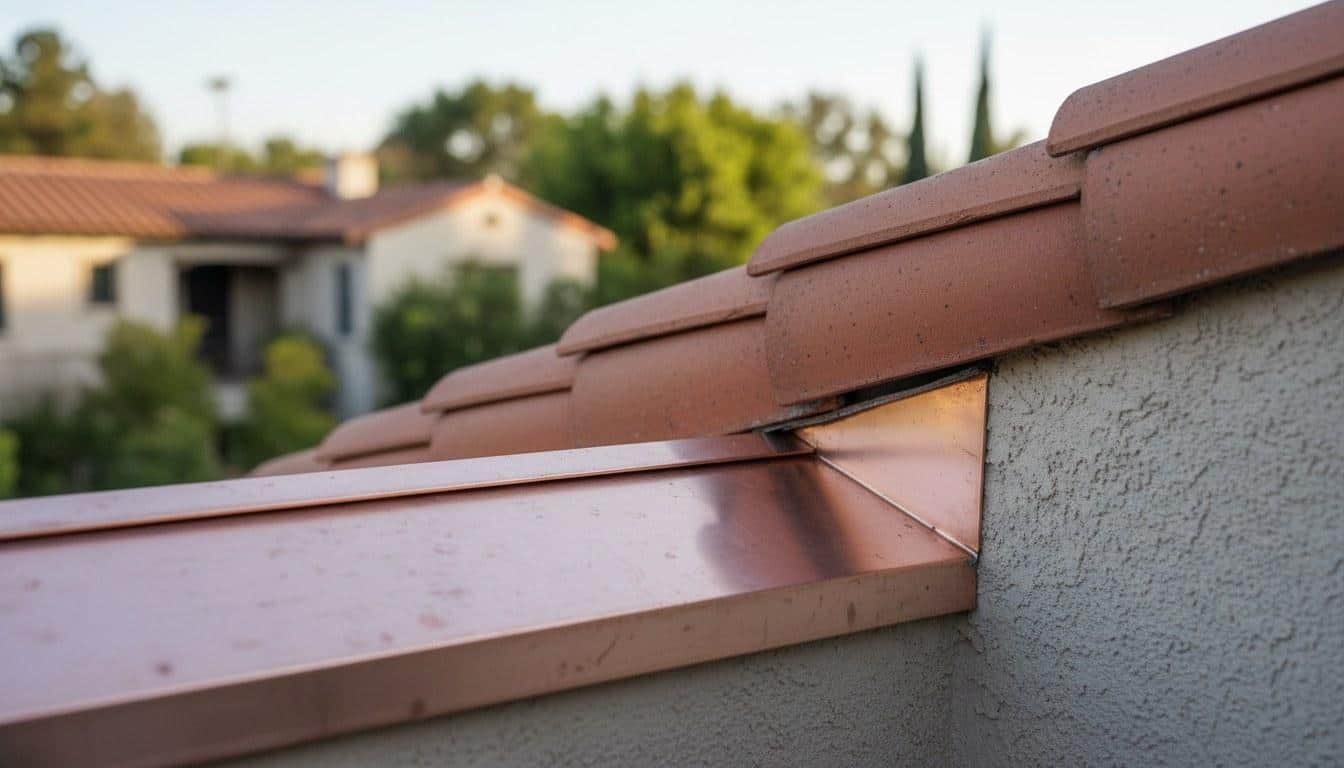
- Copper: Premium option found on high-end custom homes. Extremely durable but significantly more expensive than steel or aluminum.
- Rubberized asphalt membrane: Used as step flashing backup on TPO flat roofs and low-slope residential decks common in West LA and Santa Monica.
Flashing fails for four main reasons: sealant dries out and cracks, fasteners back out from thermal movement, the metal corrodes, or improper original installation leaves gaps. Once water gets under the flashing, it soaks into the roof deck, travels along rafters, and often shows up as a stain on a ceiling far from the actual entry point.
Our team has responded to flashing-related leak calls across Los Angeles and finds that in roughly 6 out of 10 cases, the visible ceiling stain is at least 3 feet away from the actual flashing gap — which is why a visual inspection from inside the attic is always part of a proper flashing diagnosis.
In roughly 6 out of 10 cases, the visible ceiling stain is at least 3 feet away from the actual flashing gap.
What Does Affordable Roof Repair for Flashing Cost in Los Angeles in 2026?
Roof flashing repair projects in the Los Angeles, CA market typically range from about $200 for a simple sealant reapplication to $1,500 or more for a full chimney flashing replacement on a tile roof. Larger or more complex jobs — like re-flashing an entire flat roof parapet or replacing step flashing along a two-story dormer — can run higher depending on scope and access difficulty.
The table below shows common flashing repair scenarios and typical market ranges as of 2026. These are regional market estimates based on scope — they are not quotes from Roof Repair & Construction Inc. and actual pricing depends on your specific project.
| Scenario | Typical Market Range (Los Angeles) | What’s Usually Included |
|---|---|---|
| Sealant reapplication around a vent pipe or skylight | $200 – $400 | Remove old sealant, clean joint, apply new flashing-grade sealant or tape, inspect surrounding shingles |
| Step flashing replacement along a dormer or wall (up to 10 linear feet) | $400 – $800 | Remove shingles adjacent to wall, install new metal step flashing, re-lay shingles, seal |
| Chimney flashing replacement (standard single-story asphalt shingle roof) | $600 – $1,200 | Remove old base and counter flashing, repoint mortar joints if needed, install new step and cap flashing, seal |
| Chimney flashing on clay or concrete tile roof | $900 – $1,500+ | Careful tile removal and reinstallation, custom-bent flashing to match tile profile, mortar work, seal |
| Parapet wall or flat-roof edge flashing (per 20 linear feet) | $500 – $1,100 | Remove failing metal or membrane flashing, install new coping or drip edge, seal to TPO or modified bitumen field |
Prices move based on roof pitch, material type, access difficulty, and whether permits are required. Los Angeles Department of Building and Safety (LADBS) typically requires a permit for full flashing replacement on a primary structure — a licensed contractor will confirm what applies to your specific project.
What Affects the Cost of Roof Flashing Repair in Los Angeles?
Six factors consistently move the price of a flashing repair up or down in the Los Angeles market. Understanding them helps homeowners compare quotes fairly.
- Roof pitch and access: A low-slope or flat roof is faster and safer to work on than a steep 8:12 or 10:12 pitch. Steeper roofs require more safety equipment and take longer, which raises labor cost.
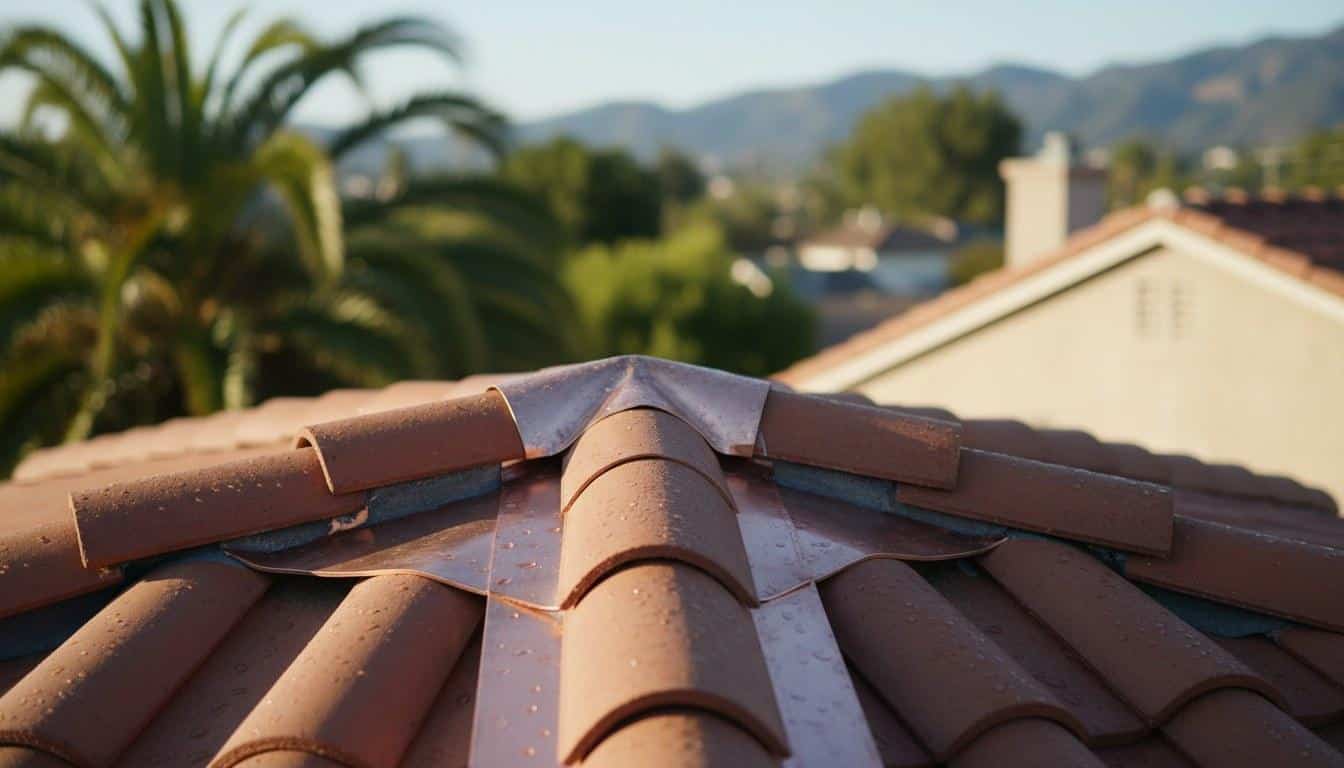
- Roof material: Asphalt shingle is the most forgiving to work around. Clay and concrete tile — common across much of Los Angeles, CA — must be carefully removed and reinstalled without cracking, adding time and skill requirements.
- Flashing material chosen: Galvanized steel is the most affordable option. Copper can cost 3 to 5 times more per linear foot but lasts significantly longer. Aluminum falls in the middle.
- Extent of water damage: If water has been entering for months, the roof deck, sheathing, or rafters underneath may be soft or rotted. Replacing damaged decking typically adds $300 to $700 or more to the project cost depending on the area affected.
- Number of penetrations: A roof with one vent pipe is simpler than a roof with a chimney, two skylights, a solar conduit, and three vent stacks. Each penetration is a separate flashing detail.
- Permit and inspection fees: The City of Los Angeles charges permit fees based on project valuation. These are real costs that a legitimate, licensed-by-the-California Contractors State License Board (CSLB) contractor will include in their written estimate.
For a custom quote that reflects your specific roof, contact Roof Repair & Construction Inc. directly at (323) 474-1088.
What Is NOT Included in a Standard Flashing Repair Quote?
Most standard flashing repair quotes cover labor, new flashing material, and sealant for the specific area being repaired — but several related items are commonly billed as add-ons and can surprise homeowners.
- Roof deck or sheathing replacement: If the decking beneath the flashing has rotted from prolonged water exposure, that is almost always a separate line item.
- Interior water damage repair: Drywall patching, painting, or mold remediation inside the home is outside the scope of a roofing contractor and requires a separate specialist.
- Chimney masonry repair: Repointing deteriorated mortar joints on a brick or block chimney is often needed alongside flashing work but is quoted separately.
- Full shingle replacement in the repair zone: Some older shingles crack or break when lifted for flashing access. Replacing a small field of shingles may be added to the invoice.
- Permit fees: As noted above, Los Angeles permit fees are a real project cost. Confirm whether they are included in the quote or billed at cost.
- Emergency or after-hours service: Calls made during a rainstorm or on weekends typically carry a service premium in the LA market.
How Do You Get an Accurate Quote for Roof Flashing Repair in Los Angeles?
The most accurate quotes come from an in-person inspection, not a phone estimate. A roofer who has physically looked at the flashing, the surrounding material, and the attic below will give you a far more reliable number than one working from a description or a satellite image.
Before you call an affordable roof repair contractor, have this information ready:
- Your roof’s approximate age and material type (asphalt shingle, clay tile, concrete tile, metal, TPO flat)
- The location of the suspected leak — which room shows the stain, and roughly where on the roof it might be above
- Whether you have had any prior repairs in the same area
- Your home’s address and ZIP code — slope, exposure, and local code requirements vary across Los Angeles ZIP codes like 90001 through 91342
- Whether you are filing an insurance claim — if so, your insurer may require a written scope of loss before authorizing repairs
California homeowners should also know that since California’s Title 24 building energy standards were updated, any re-roofing project over a certain threshold may trigger cool-roof requirements for the replaced surface area. A licensed contractor will flag this if it applies to your project.
Across our service calls in Los Angeles, we see roughly 40% of homeowners wait more than 6 months after noticing a ceiling stain before calling a roofer — by which point the average repair scope has expanded to include at least some deck work, not just flashing alone.
Roughly 40% of homeowners wait more than 6 months after noticing a ceiling stain before calling a roofer — by which point the average repair scope has expanded to include at least some deck work, not just flashing alone.
Get at least two written quotes. Each quote should clearly list the flashing material, the scope of work, permit responsibility, and a warranty on labor. Comparing quotes on those four points is more useful than comparing bottom-line numbers alone.
Request a Custom Quote for Affordable Roof Repair in Los Angeles, CA
The market ranges in this guide give you a realistic starting point, but your actual cost depends entirely on your roof’s specific condition, material, and scope. The numbers above are regional market context — they are not Roof Repair & Construction Inc.’s rates, and no contractor should quote a firm price without seeing the roof in person.
Roof Repair & Construction Inc. serves homeowners across Los Angeles, CA — from Inglewood and Lawndale to Santa Monica and the San Fernando Valley. Call (323) 474-1088 to schedule an on-site inspection and get a written quote for your flashing repair. Same-week appointments are typically available across most Los Angeles ZIP codes.
Whether you have a single failing vent pipe seal or a full chimney flashing replacement on a clay tile roof, Roof Repair & Construction Inc. provides written, itemized estimates so you know exactly what you are paying for before any work begins.
Frequently Asked Questions
How do I know if my roof flashing needs to be repaired or replaced?
If you see rust stains running down from a chimney, lifted or buckled metal strips along a roof edge, or a water stain on your ceiling near a skylight or vent, those are signs your flashing has failed. In Los Angeles, CA, flashing that is more than 15 to 20 years old and showing visible separation or corrosion is usually better replaced than patched. A licensed roofer can tell you which approach makes sense after a visual inspection.
How do you apply flashing on a roof without walking on it?
You can spot early flashing problems from the ground using binoculars — look for lifted metal edges, missing sealant, rust streaks, or gaps between the flashing and the chimney or wall. For a proper repair, though, a contractor needs to access the roof safely. In Los Angeles, steep tile roofs especially require a professional with the right equipment. Attempting to walk on clay or concrete tile without experience risks cracking tiles and creating new leak points.
How much does roof flashing repair usually cost in Los Angeles?
In the Los Angeles, CA market as of 2026, flashing repairs typically range from around $200 for a simple sealant reapplication to $1,500 or more for a full chimney flashing replacement on a tile roof. The price depends on the roof material, the type of flashing needed, and whether any underlying deck damage needs to be addressed. Call (323) 474-1088 to get a written quote for your specific situation from Roof Repair & Construction Inc.
What is the difference between step flashing and counter flashing on a roof?
Step flashing is a series of small L-shaped metal pieces woven into the shingles along a sloped roof edge where it meets a wall or chimney — each piece overlaps the one below it to direct water down and away. Counter flashing is a second layer installed above the step flashing, embedded into the mortar joints of the chimney or wall, that covers the top edge of the step flashing and prevents water from getting behind it. Both layers need to be intact for the system to work. In Los Angeles, CA, counter flashing on brick chimneys often fails first because the mortar joints dry out faster in the hot, dry climate.
Can I file a homeowner's insurance claim for roof flashing damage in California?
It depends on the cause of the damage. In California, homeowner's insurance typically covers flashing damage caused by a sudden event — like a Santa Ana wind storm lifting the flashing — but generally does not cover damage from gradual wear and deferred maintenance. If you believe a wind or storm event caused the failure, document it with photos and dates and contact your insurer promptly, as California policies typically have claim filing windows. An affordable roof repair contractor can provide a written scope of loss to support your claim.