Failing roof flashing is the leading cause of leaks in Southern California homes. This guide covers what to look for, when to call a licensed roofer, and what the repair process involves.
Failing roof flashing is the leading cause of leaks in Southern California homes. This guide covers what to look for, when to call a licensed roofer, and what the repair process involves.
Roof repair in Southern California starts with one of the most overlooked components on any roof: the flashing. Flashing is the thin metal material, usually galvanized steel, aluminum, or lead, installed at every joint, seam, and penetration on your roof. When it fails, water gets in. And in Southern California, flashing fails faster than most homeowners expect. If you have a leak or suspect one, this guide walks you through exactly what to look for and when to act.
For a full breakdown of what roof repair costs in this market, see our detailed guide: How Much Does Roof Repair Cost in Southern California? This article goes deeper on the flashing problem specifically, the cause behind most of the leaks we see.
Why Southern California Roofs Are Especially Hard on Flashing
Southern California sits in a Mediterranean climate zone with UV radiation levels that degrade roofing sealants up to 40% faster than in temperate northern climates. The combination of intense summer heat, dry Santa Ana winds in fall, and brief but heavy winter rain events puts constant stress on every sealed joint on your roof.
According to the National Weather Service Southern California office, the region receives most of its annual rainfall in just 3 to 4 months, typically December through March. That means roofs sit bone-dry for up to 8 months, allowing sealants to crack and shrink, then face sudden heavy downpours that exploit every gap.
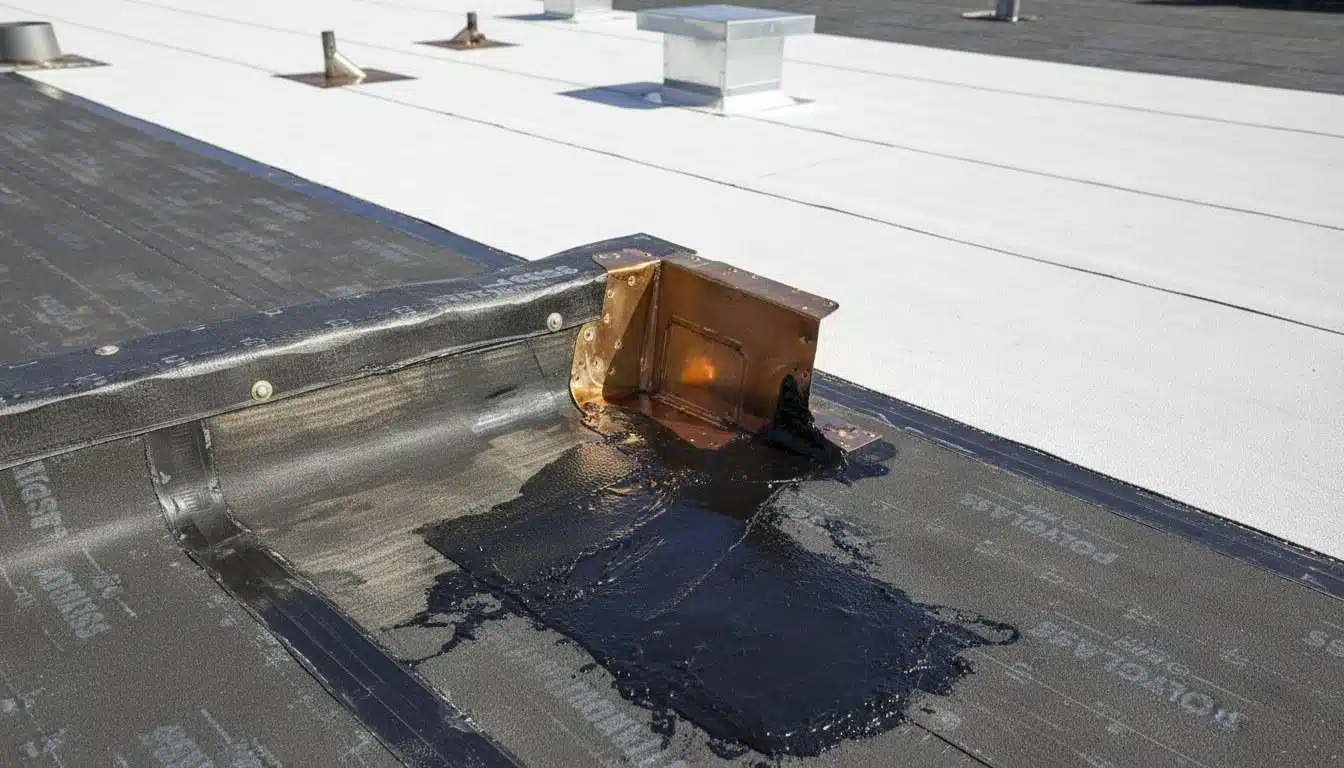
Santa Ana wind events, which regularly hit 50 to 70 mph in the hills above the region, can physically lift or separate flashing that was only marginally attached. ZIP codes in the 90012 to 90017 range sit in the urban core where flat and low-slope roofs with TPO and modified bitumen membranes are common, and those roof types depend heavily on correctly installed metal flashing at every edge and penetration.
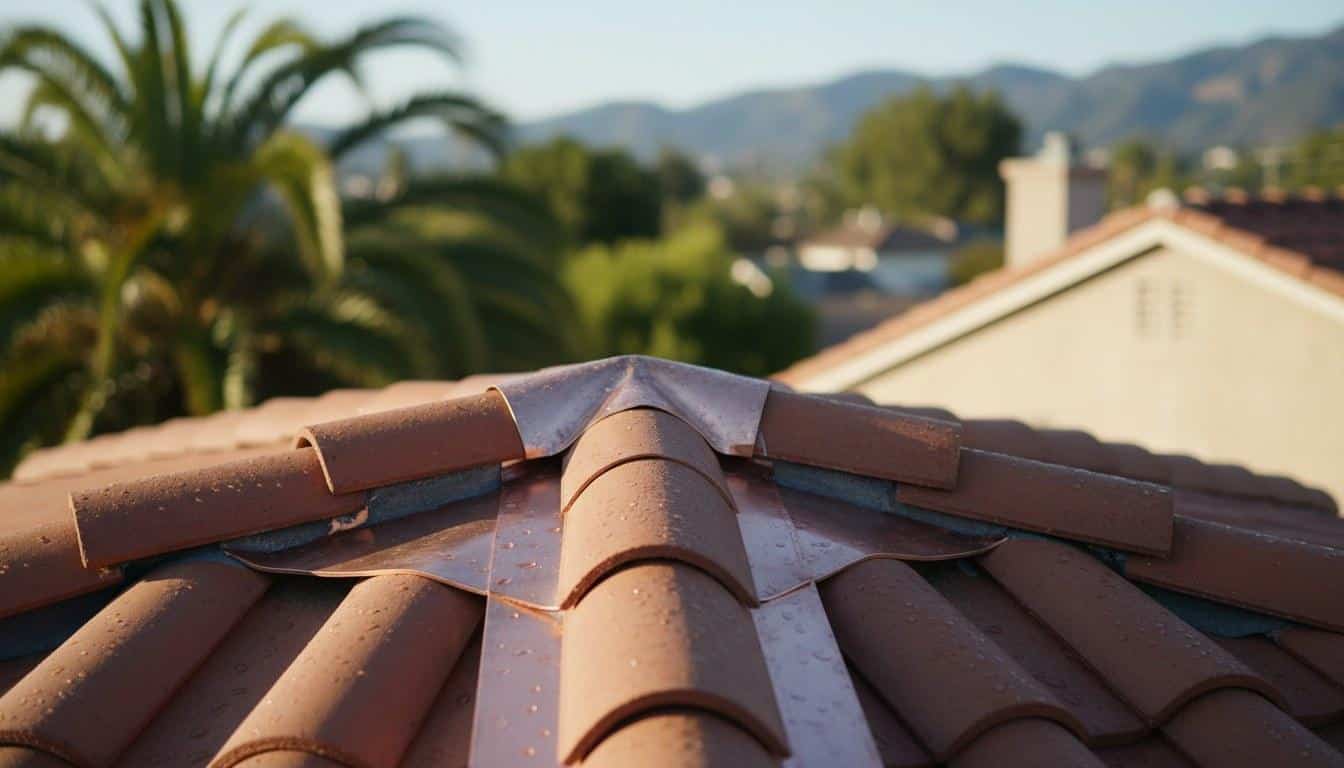
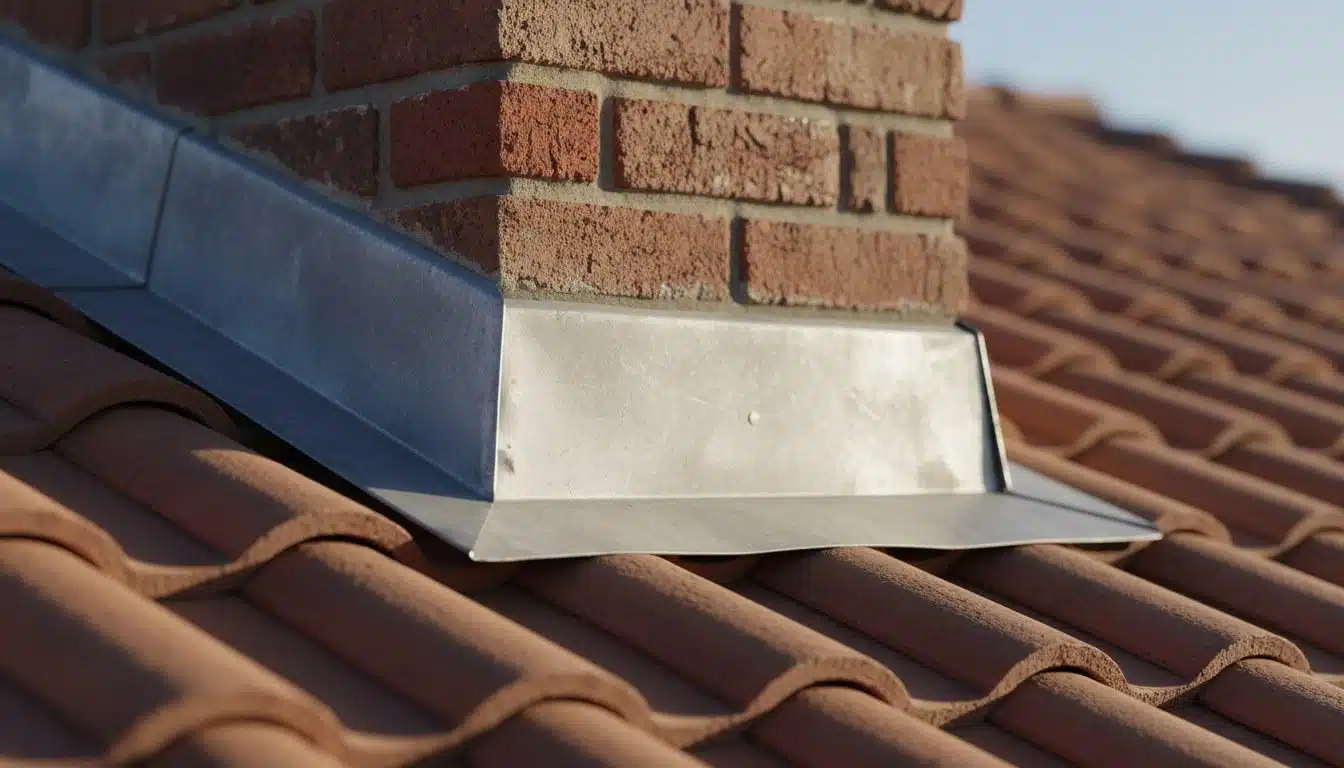
Homes with clay or concrete tile roofs, very common across the Southern California market, face an additional problem. Tile roofs use valley flashing and step flashing at every course change. When those metal strips corrode or shift, water channels directly into the roof deck beneath the tile, often going undetected for months.
What Are the Warning Signs of Flashing Failure You Can Spot from the Ground?
Most flashing failures give visible clues you can see from your yard or driveway without ever climbing a ladder. Knowing what to look for saves time and helps you describe the problem accurately when you call a roofer.
- Rust streaks on exterior walls: Orange or brown staining running down the siding or stucco below a chimney or skylight is a classic sign that metal flashing is corroding and letting water through.
- Lifted or buckled shingles near a wall: Where a roof meets a vertical wall, step flashing sits behind each shingle course. If shingles look raised or wavy in that zone, the flashing beneath may have shifted.
- Visible gaps at the chimney base: From the ground with binoculars, look for any daylight or separation between the chimney masonry and the metal cap flashing or counter-flashing above it.
- Dark staining on roof valleys: Valleys are the V-shaped channels where two roof planes meet. Dark streaking or moss growth in a valley often means water is pooling because the valley flashing is damaged or improperly lapped.
- Interior water stains on ceilings: A brown or yellow ring on a ceiling directly below a skylight, chimney, or roof-to-wall joint is a strong indicator of flashing failure, not a shingle problem.
- Peeling paint near the roofline: Moisture migrating through failed flashing can cause exterior paint to bubble or peel within 12 to 18 inches of the eave or fascia.
Our crews respond to flashing-related leak calls across Southern California at a rate of roughly 3 to 1 compared to pure shingle failures, meaning for every shingle leak we repair, we find three that trace back to failed metal flashing or compromised sealant at a penetration point.
For every shingle leak we repair, we find three that trace back to failed metal flashing or compromised sealant at a penetration point.
How Can You Safely Inspect for Flashing Problems Without Getting on the Roof?
A homeowner can gather most of the diagnostic information a roofer needs without ever stepping onto the roof surface. Walking on a roof without proper equipment and training is dangerous, and on tile roofs it causes additional damage. Here is a safe inspection sequence you can follow from the ground and from inside the attic.
- Binocular scan from the yard: Use 8x or 10x binoculars to examine the chimney base, all skylight perimeters, any pipe boots or vent collars, and the roof valleys. Look for separation, rust, or missing sealant.
- Attic check after a rain event: Within 24 hours of a rain, go into the attic with a flashlight. Look for active dripping, wet insulation, or water staining on the underside of the roof deck. Mark the wet spot with chalk and measure its distance from the nearest wall or ridge; this helps a roofer locate the entry point from above.
- Photograph ceiling stains with timestamps: If you have interior staining, photograph it immediately and note the date. Insurance adjusters and roofers both need documentation of when the damage appeared. California homeowners generally have a 1-year window from the date of discovery to file a homeowners insurance claim for sudden water intrusion, though policy terms vary.
- Check gutters for granules and rust flakes: After a rain or wind event, look inside your gutters. Asphalt shingle granules are normal in small amounts, but rust-colored flakes or large chunks of dried sealant indicate flashing is deteriorating.

When Does a Flashing Problem Become an Emergency Repair?
A flashing leak becomes an emergency when water is actively entering the living space, when mold is visible, or when the roof deck itself shows signs of rot. In Southern California, the window between a minor flashing gap and serious structural damage can be as short as one rainy season, roughly 90 days.
Here is a quick decision guide to help you assess urgency:
| Symptom | Likely Cause | Urgency Level |
|---|---|---|
| Ceiling stain, dry to the touch, no active drip | Past flashing leak, may be sealed or slow | Schedule within 2 to 4 weeks |
| Active drip during or after rain | Open flashing gap or failed sealant | Call within 24 to 48 hours |
| Soft or spongy ceiling drywall | Saturated insulation, possible deck rot | Same-day or next-day repair |
| Visible mold on ceiling or attic framing | Chronic moisture intrusion, likely 60+ days | Emergency, call immediately |
| Rust stains on exterior wall only, no interior sign | Surface corrosion, flashing intact but aging | Schedule within 4 to 8 weeks |
Water damage to roof decking and framing typically adds between $800 and $3,500 to a repair scope, depending on how many square feet of sheathing need replacement. Catching a flashing gap before the deck is compromised is almost always the lower-cost path.
Water damage to roof decking and framing typically adds between $800 and $3,500 to a repair scope, depending on how many square feet of sheathing need replacement.
As of 2024, California’s Title 24 building energy standards also require that any roof repair involving more than 50% of the roof surface meet current insulation and reflectivity standards. A licensed roofer will flag this threshold before work begins so you are not caught off guard by permit requirements. You can review the current standards at the California Energy Commission’s building standards page.
What Does a Licensed Roofer Actually Do During a Flashing Repair?
A properly licensed roofer, licensed by the California Contractors State License Board (CSLB), follows a defined process for flashing repair that goes beyond simply re-caulking a gap. Sealant-only patches on corroded or separated flashing fail within 1 to 3 years. A correct repair addresses the metal itself.
Here is what a professional roofing repair typically involves for a flashing job:
- Full diagnostic inspection: The roofer accesses the roof safely and traces the water path from the interior stain back to the actual entry point, which is often 2 to 6 feet upslope from where the stain appears on the ceiling.
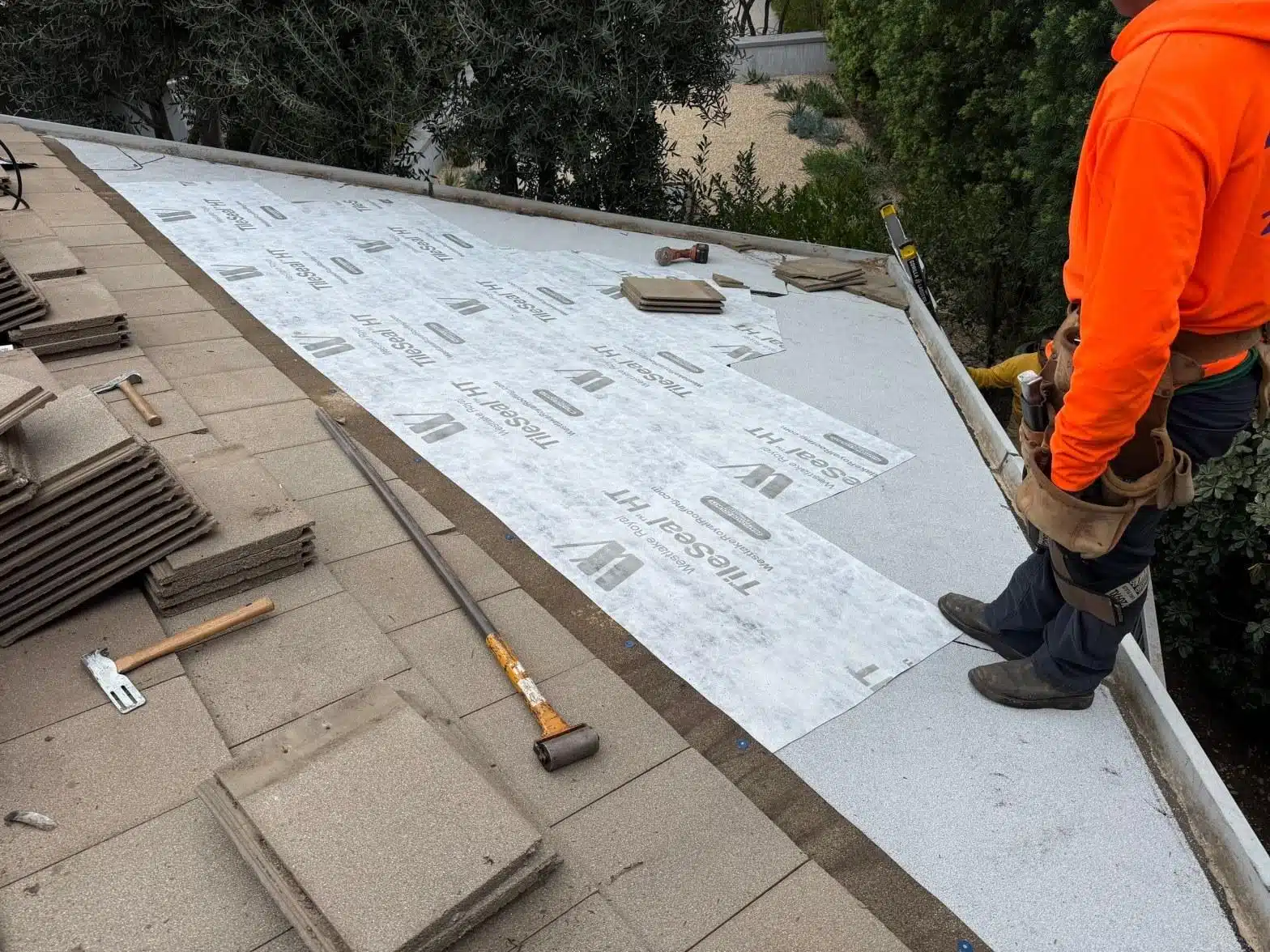
- Removal of surrounding material: On shingle roofs, the shingles around the failed flashing are carefully lifted. On tile roofs, individual tiles are removed and set aside for reinstallation. This is why a roofer needs to match your tile profile, Southern California has dozens of clay and concrete tile profiles in active use.
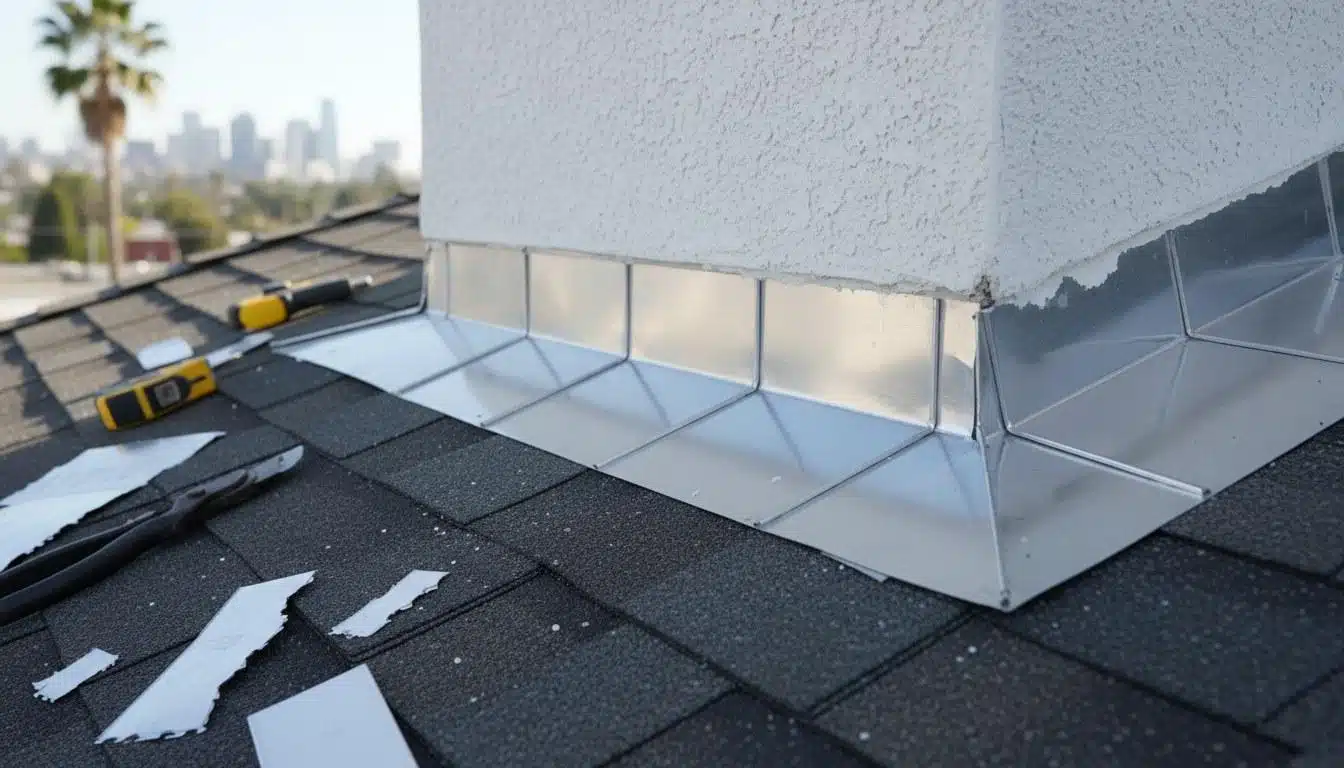
- Metal flashing replacement: Corroded or separated flashing is removed entirely. New galvanized steel or aluminum flashing is cut, bent, and installed with the correct overlap, typically a minimum 4-inch side lap and 6-inch head lap per standard practice, and secured with roofing nails or screws appropriate to the deck material.
- Sealant application: A UV-stable roofing sealant rated for the region’s temperatures (typically rated to 300 degrees F surface temperature) is applied at all metal-to-masonry or metal-to-shingle transitions.
- Permit pull if required: Permits are required for roofing work that exceeds a certain scope. Your roofer should advise you on whether a permit applies and pull it before work begins. Unpermitted work can affect your ability to sell the home or file an insurance claim later.
- Water test: A reputable roofer will run a hose test after the repair to confirm the penetration is sealed before leaving the job.
In our experience on roofing repair calls across Southern California, we find that roughly 6 out of 10 homes with active leaks have had a previous sealant-only patch applied at the same location, confirming that caulk alone is not a lasting fix on metal flashing that has physically separated or corroded through.
Roughly 6 out of 10 homes with active leaks have had a previous sealant-only patch applied at the same location, confirming that caulk alone is not a lasting fix on metal flashing that has physically separated or corroded through.
Roofing repair projects in this category typically range from $350 to $1,500 for isolated flashing repairs, depending on the number of penetrations, roof pitch, material type, and whether any decking replacement is needed. Larger chimney re-flashing jobs or full valley replacements on tile roofs can run higher. For a project-specific number, request a written quote before any work begins. You can also review general ENERGY STAR roofing product criteria to understand what materials qualify for energy-efficiency consideration when your roofer is selecting replacement components.
Get Roof Repair Help in Southern California
Schedule your roof inspection before the next rain event arrives. Flashing failures that are caught early, before the roof deck or interior framing is saturated, are straightforward repairs. Waiting costs more and creates secondary damage that takes longer to fix.
Call Roof Repair & Construction Inc. at (323) 474-1088 to book a diagnostic inspection. We serve homeowners across Southern California. Get a written quote before any work begins, no pressure, no guesswork.
Explore our full range of roofing services across Southern California.
Frequently Asked Questions
How do I know if my roof flashing is causing my leak in Southern California?
If your ceiling stain is directly below a chimney, skylight, pipe vent, or where a roof meets a wall, flashing is the most likely cause. Shingle leaks typically appear in the middle of a roof plane, not at joints or edges. A roofer can confirm the source by tracing the water path from the interior stain back to the roof surface, which is often several feet upslope from where the stain appears.
How long does a roof flashing repair take?
Most isolated flashing repairs take between 2 and 6 hours to complete. Chimney re-flashing jobs or full valley replacements on clay or concrete tile roofs can take a full day, since individual tiles must be carefully removed and reset. A roofer will give you a time estimate once they have inspected the scope on-site.
Can I just use caulk to fix a roof flashing gap myself?
A sealant-only patch on separated or corroded flashing is a temporary fix that typically lasts 1 to 3 years before failing again in the same spot. The correct repair requires removing the damaged metal and installing new flashing with the proper overlaps and fasteners. Repeated caulk patches can also trap moisture and accelerate deck rot beneath the flashing.
Does roof flashing repair require a permit?
Small isolated flashing repairs generally do not require a permit in Southern California. However, if the repair involves replacing a significant portion of the roof surface or triggers California's Title 24 threshold, typically more than 50% of the roof area, a permit is required. A licensed roofer should advise you on this before work starts and pull any required permits on your behalf.
How much does roof flashing repair usually cost in Southern California?
Flashing repair projects typically range from $350 to $1,500 for isolated repairs, depending on the number of penetrations, the roof pitch, the material type, and whether any roof deck replacement is needed. Larger jobs such as full chimney re-flashing or valley replacement on tile roofs can run higher. Contact Roof Repair & Construction Inc. at (323) 474-1088 for a written quote specific to your roof.