
What Was the Condition of the Existing Roof?
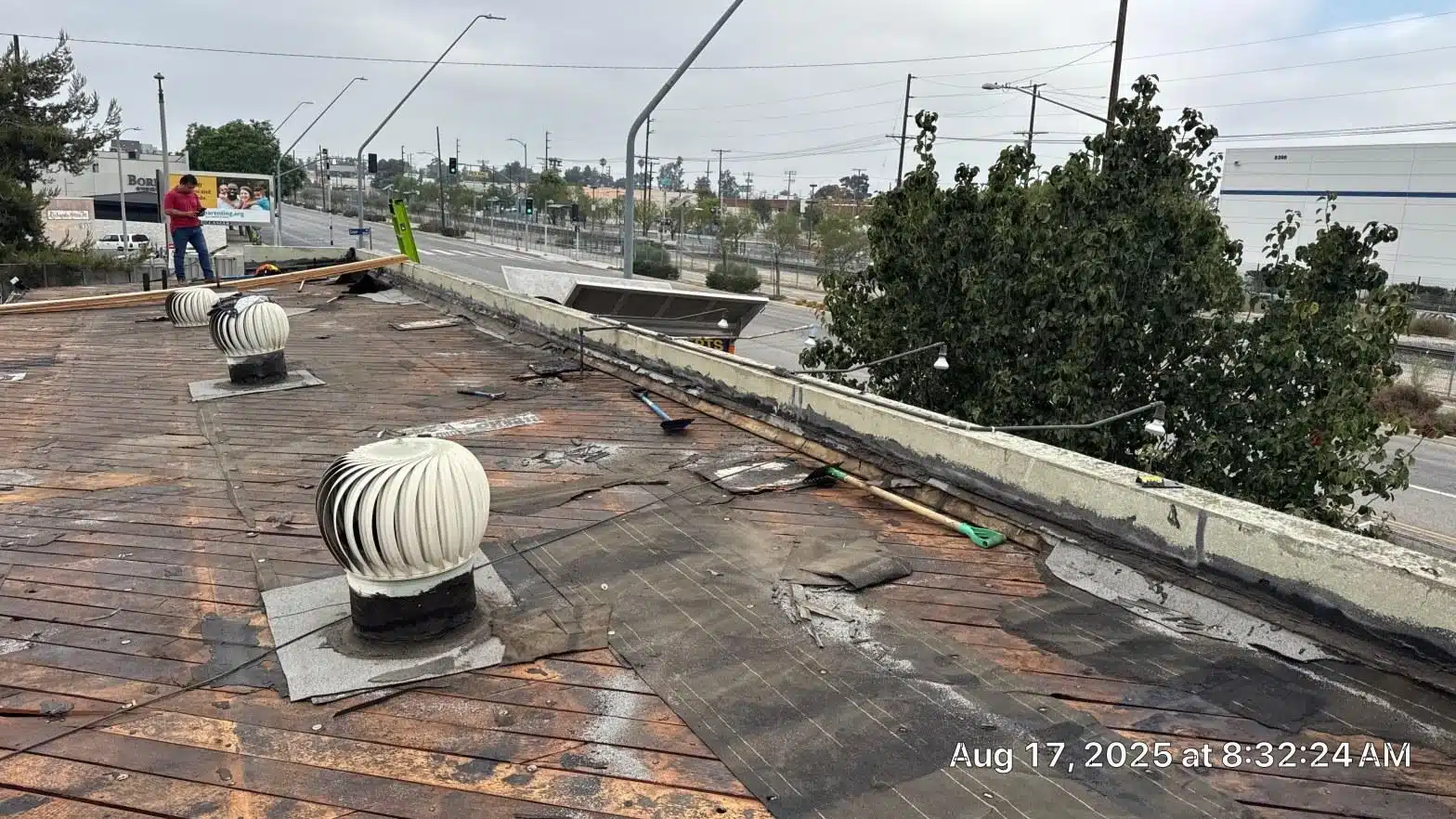
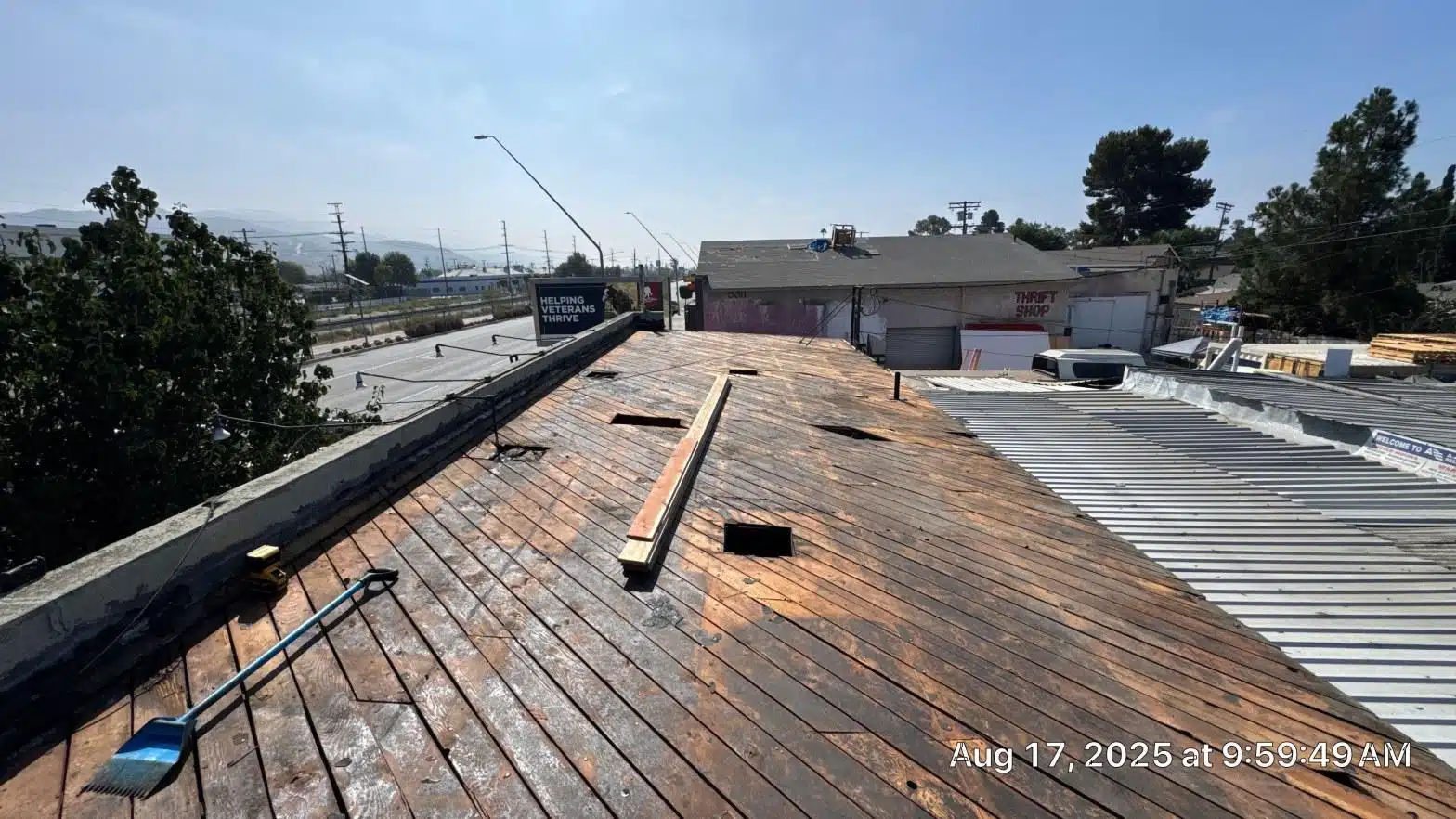
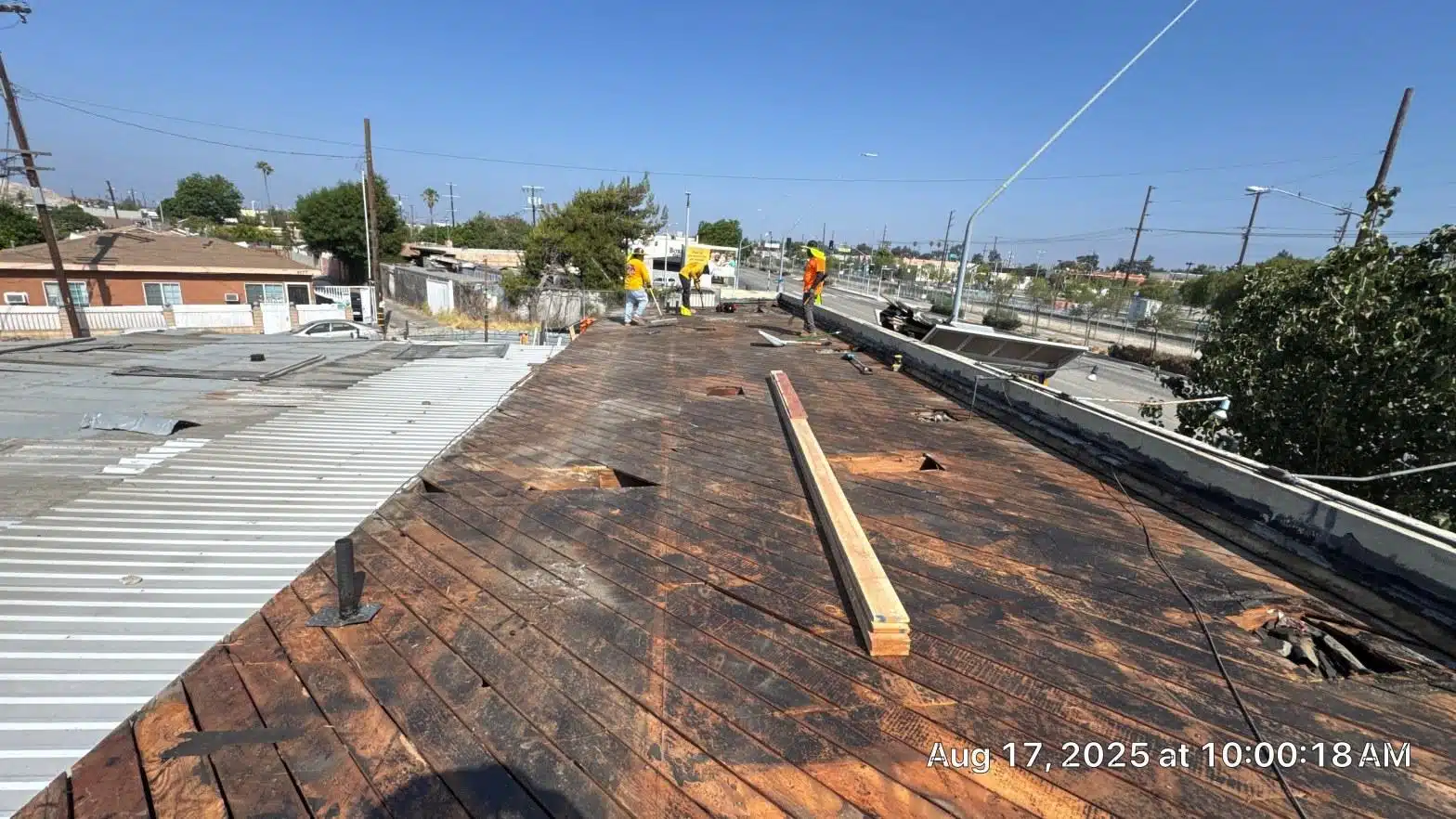
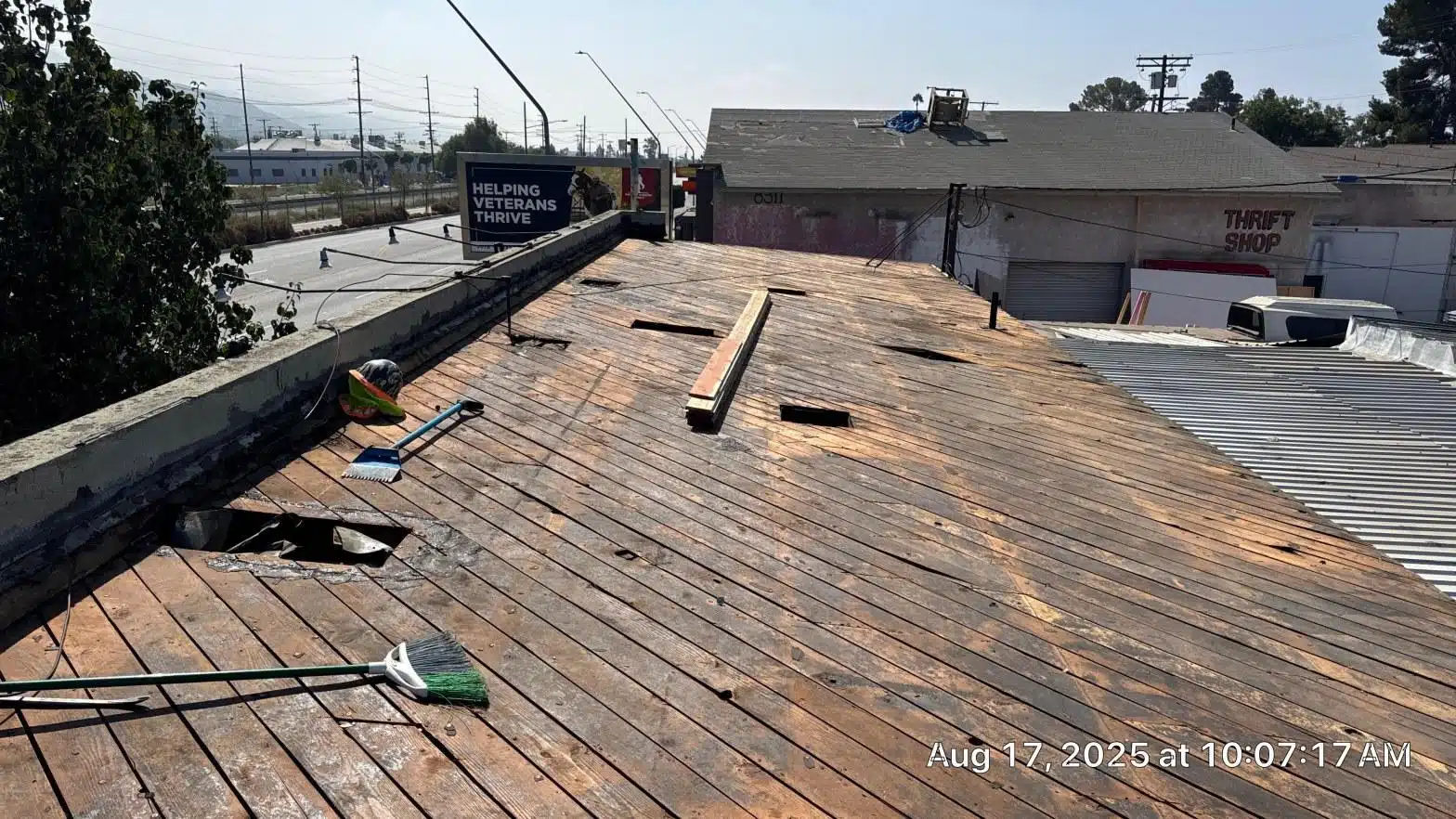
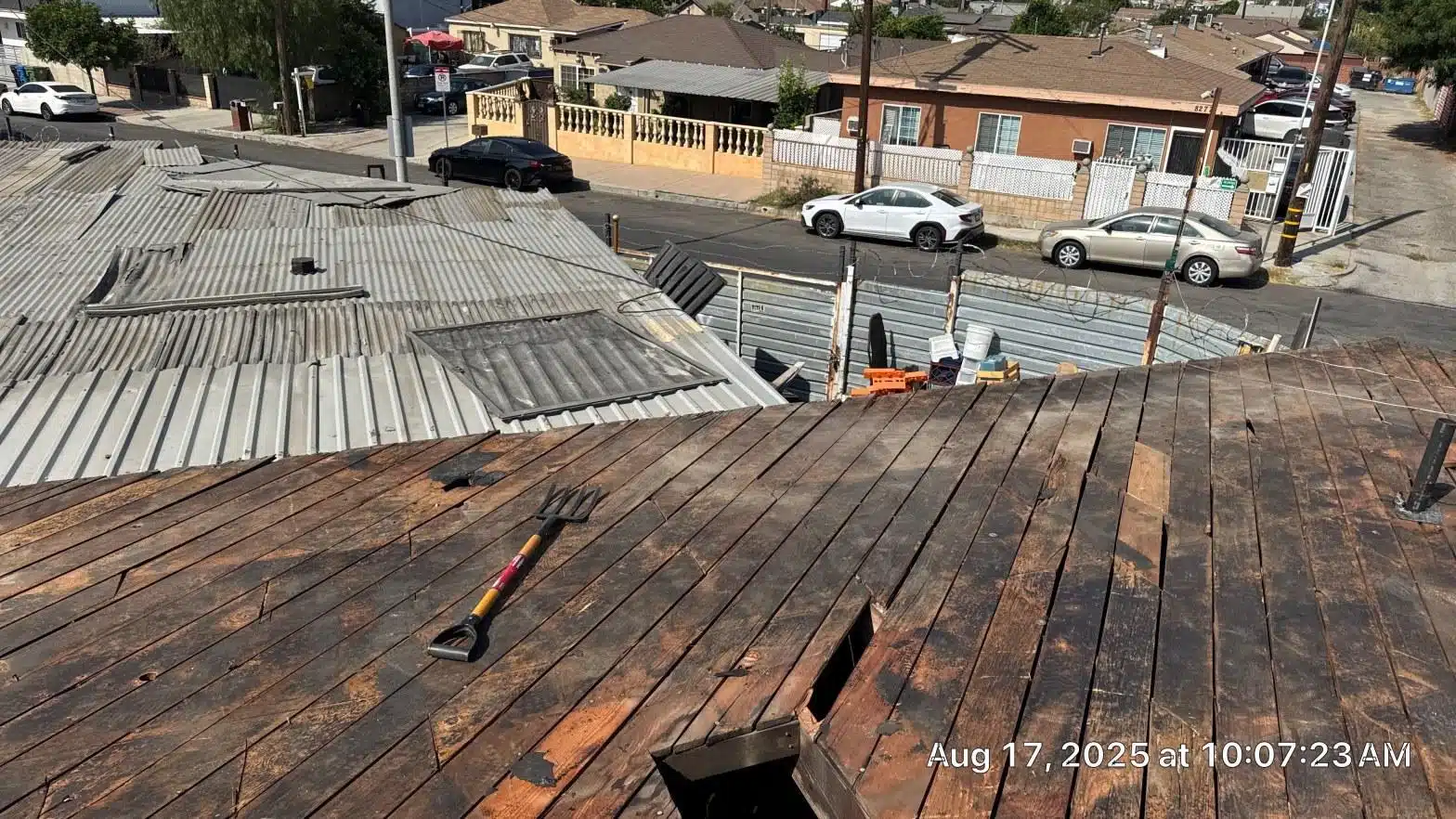
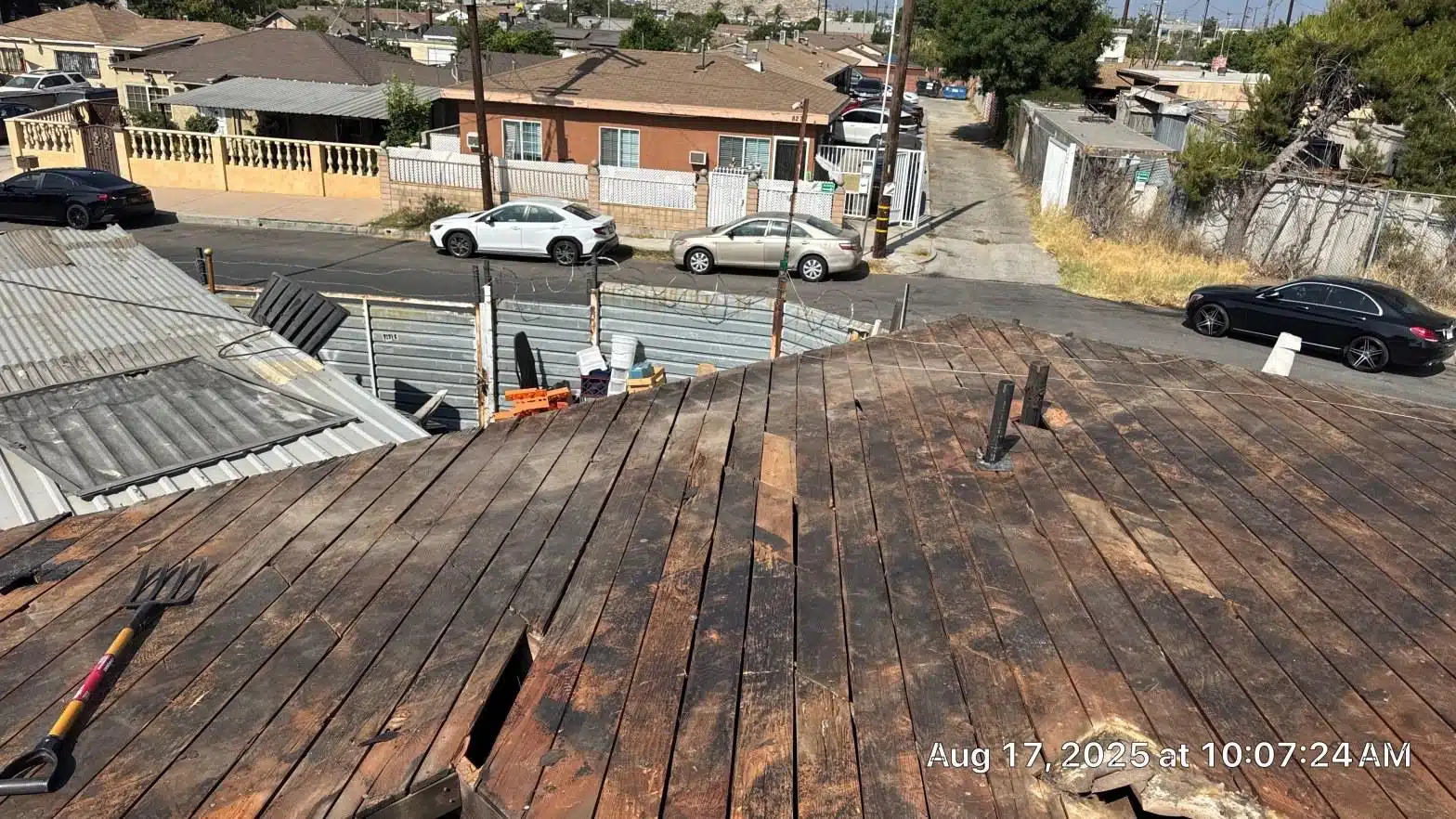
The existing membrane had failed completely, with large sections peeling away from the wood decking and leaving the building exposed to moisture intrusion. When our crew arrived on August 17, 2025, the first task was a full tear-off, pulling every layer of old roofing material back to bare wood. What we found underneath was a deck showing the staining, residual adhesive, and surface wear that accumulates when a flat roof membrane has been allowed to deteriorate past the point of repair.
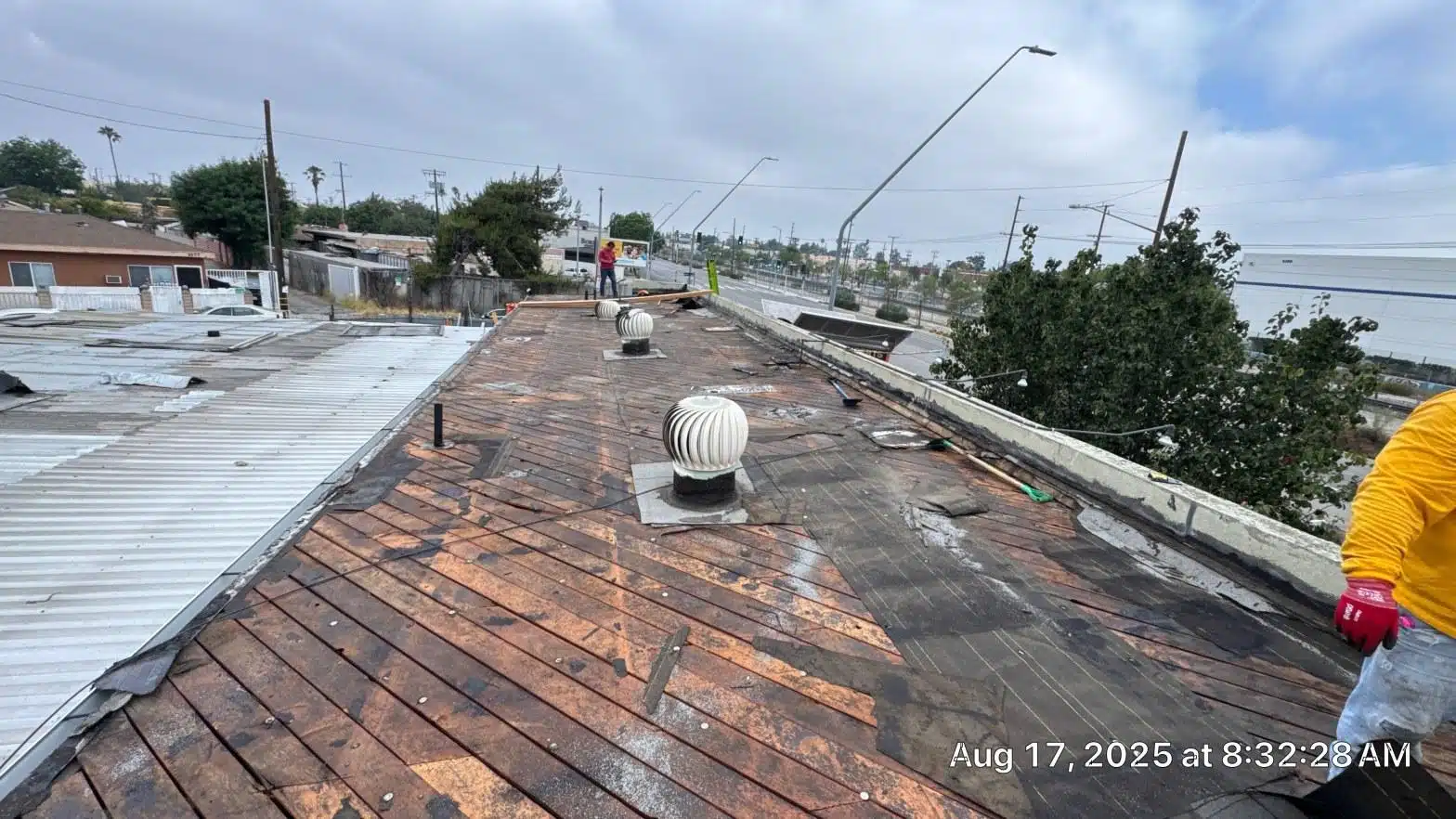
The photo above captures the deck at that moment: raw plank sheathing running the full length of the building, with the turbine vent bases still in place, exposed to an overcast sky. In Los Angeles County, coastal marine-layer moisture can infiltrate a compromised flat roof for months before visible interior damage appears, which is why a complete tear-off rather than an overlay was the right call here. Overlaying a failed membrane traps residual moisture and shortens the life of the new system. Our crew documented the deck condition board by board before any new material went down.
Why Modified Bitumen for This Building?
Modified bitumen is one of the most proven systems for low-slope commercial roofs in Southern California, combining a reinforced polymer-modified asphalt layer with granule surfacing that reflects heat and resists UV degradation. For a building of this footprint in the Los Angeles area, a two-layer torch-applied system offers waterproofing performance that single-ply alternatives at a comparable price point often cannot match on wood-deck substrates.
California’s Title 24 building energy standards, administered by the California Energy Commission, set cool-roof reflectance requirements for low-slope commercial roofing. The granule-surfaced cap sheet used on this project carries a light gray finish that supports compliance with those reflectance thresholds, reducing summertime heat gain through the roof plane. Southern California summers regularly push ambient temperatures above 95°F, which makes surface reflectance a meaningful operating cost factor for any unconditioned or lightly conditioned commercial space.
Across the flat commercial roofs we work on in the region, we find that torch-down systems on properly prepped wood decks consistently perform for 15 to 20 years when seams and penetrations are correctly detailed at installation. Getting those details right at the vent and pipe locations is where most early failures originate.
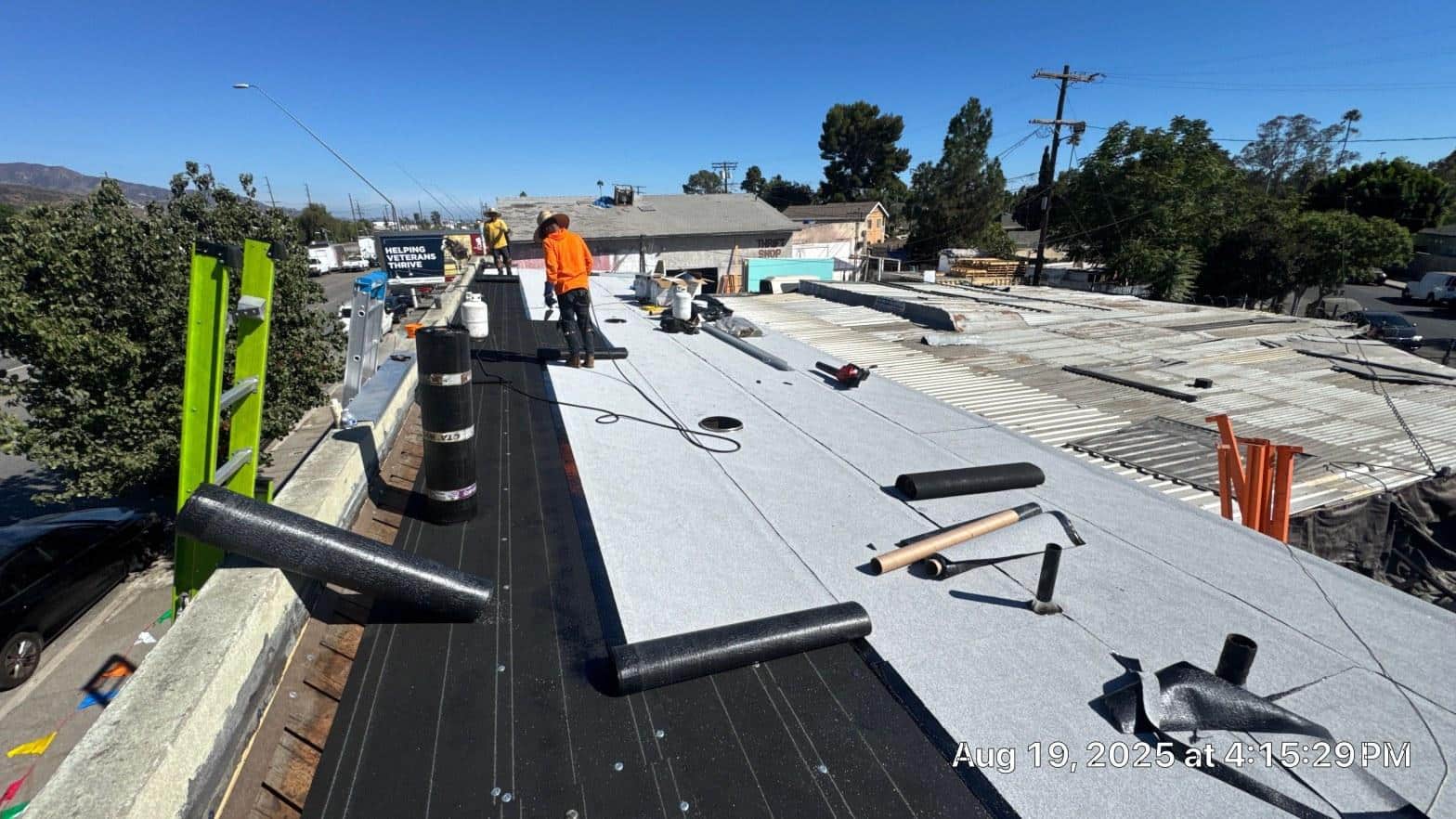
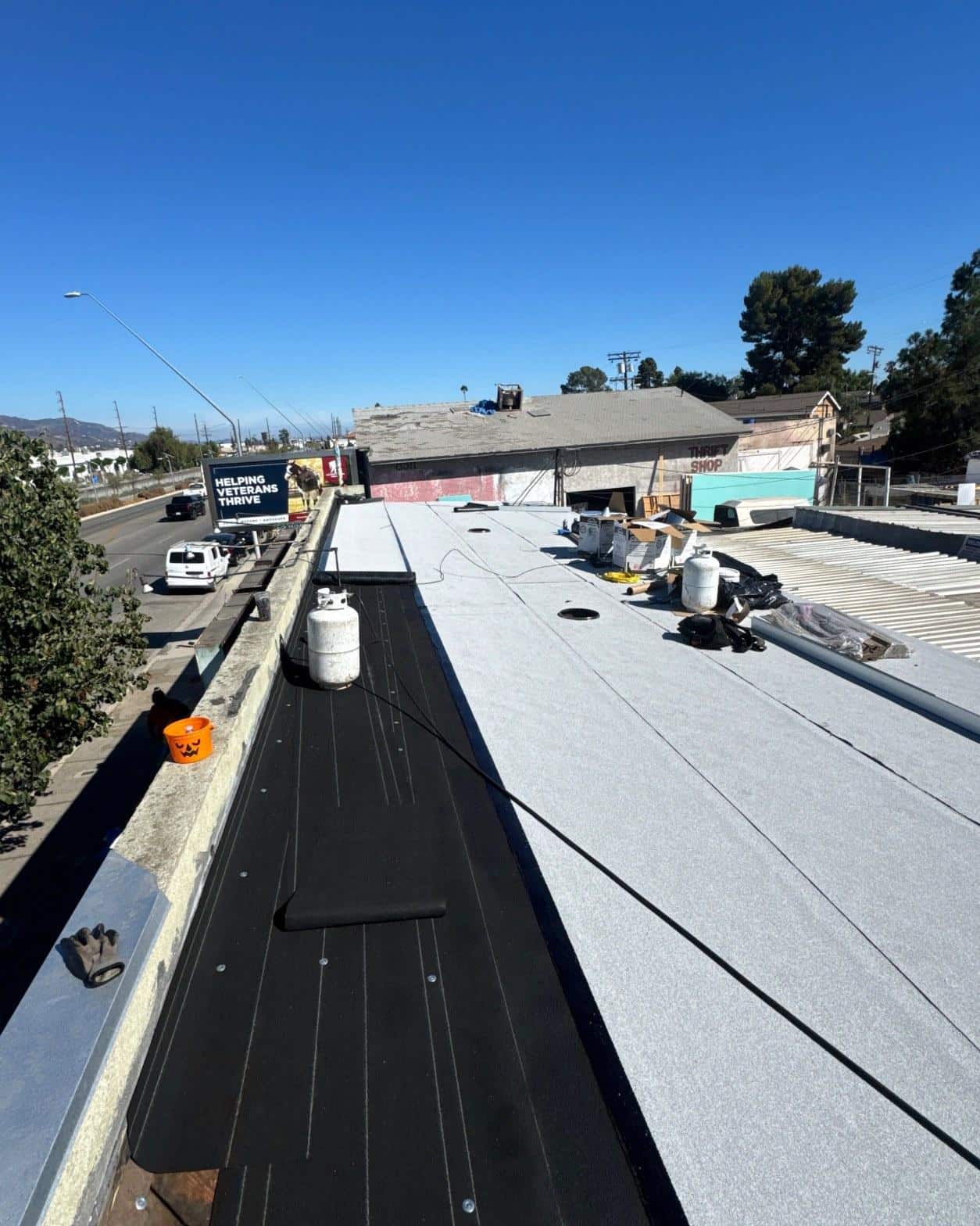
The installation photo shows two crew members working their way across the deck on August 19, 2025, with rolls of cap sheet already partially laid out and a propane torch cylinder staged nearby. The black base sheet covers the near half of the deck while the granule-surfaced gray cap sheet advances across the field. Rolls of material are visible at multiple positions, which reflects how torch-down work is paced: short sections are torched and pressed in sequence to maintain consistent bond temperature and avoid bubbling.
How Were the Vents and Pipe Boots Handled?
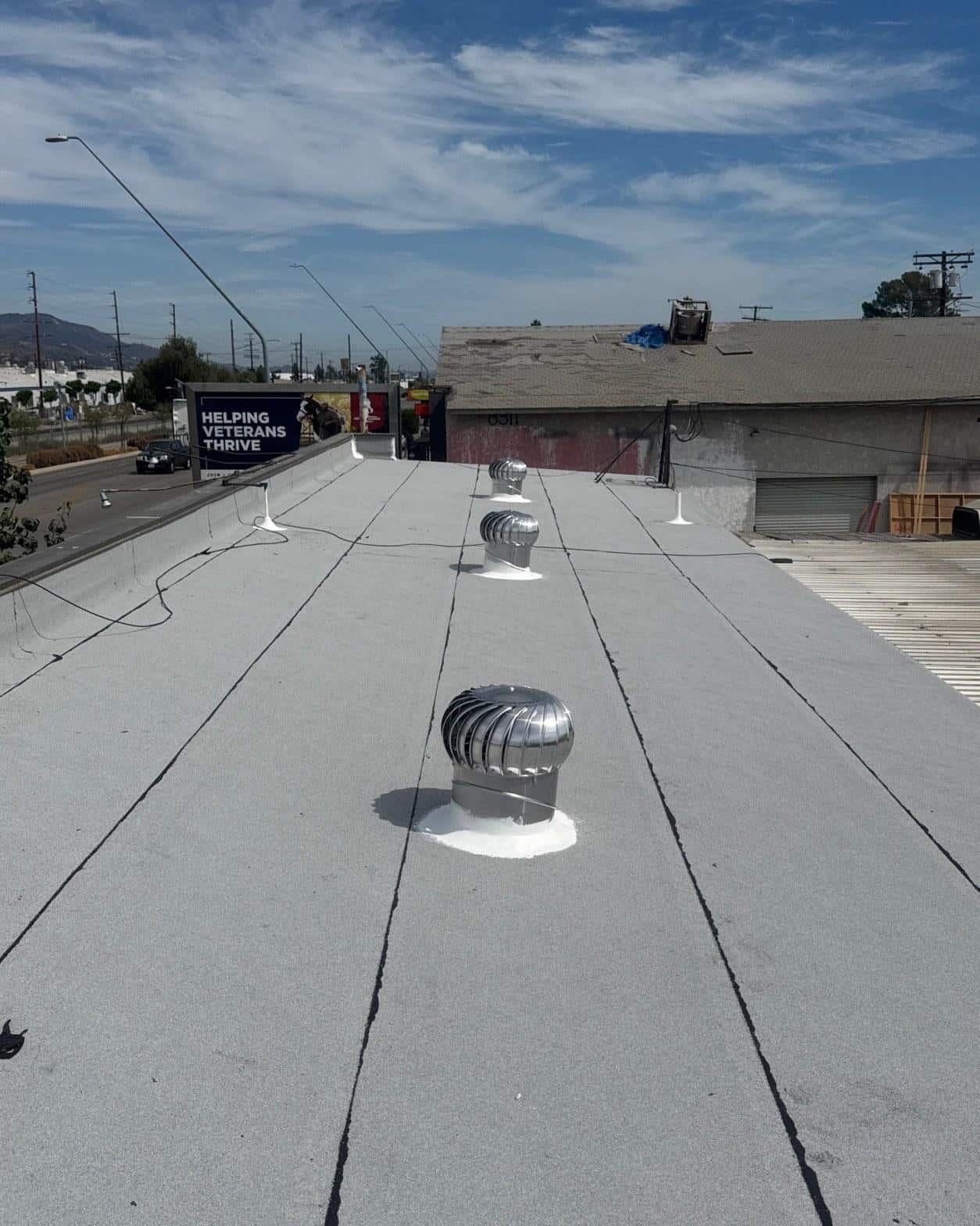
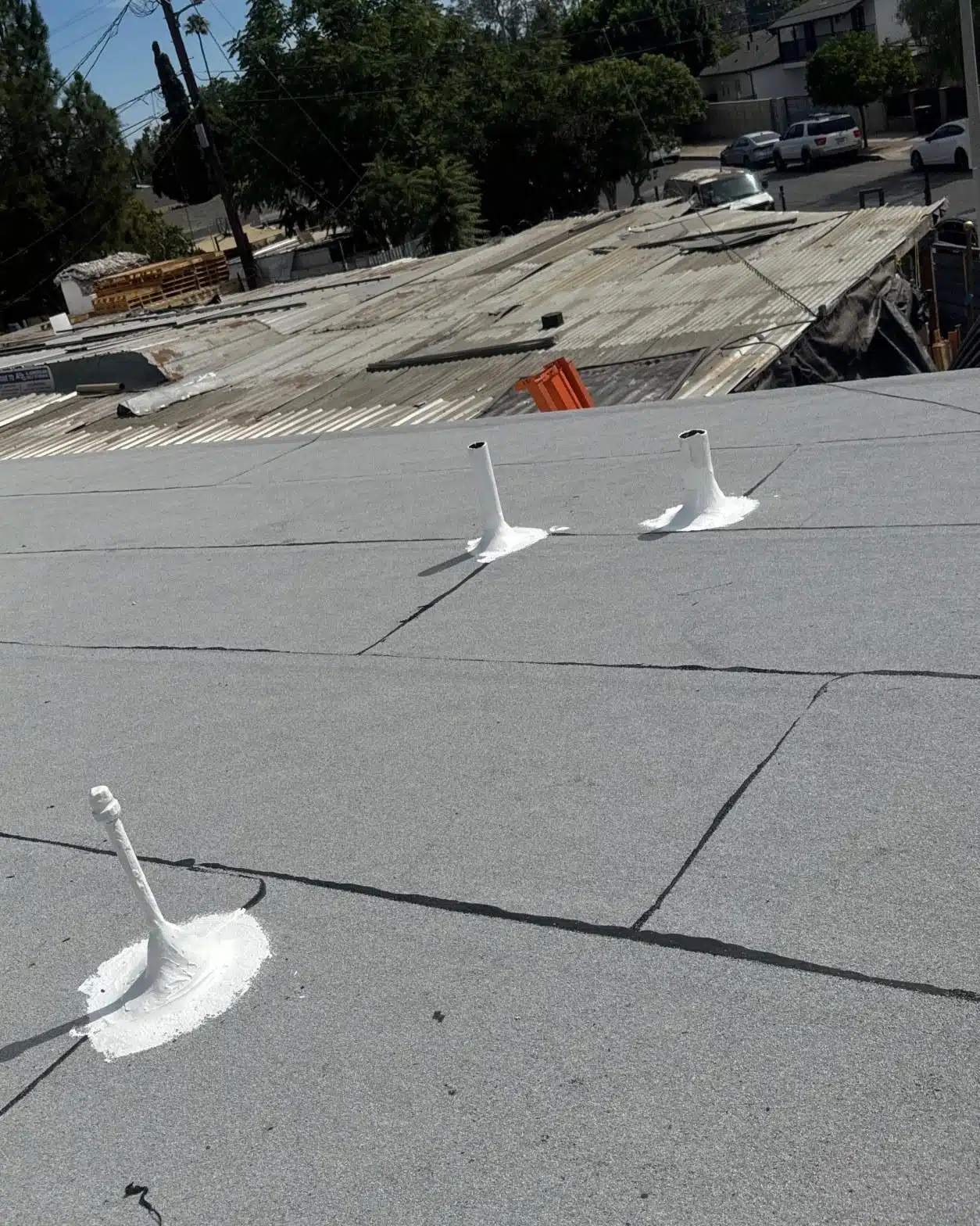
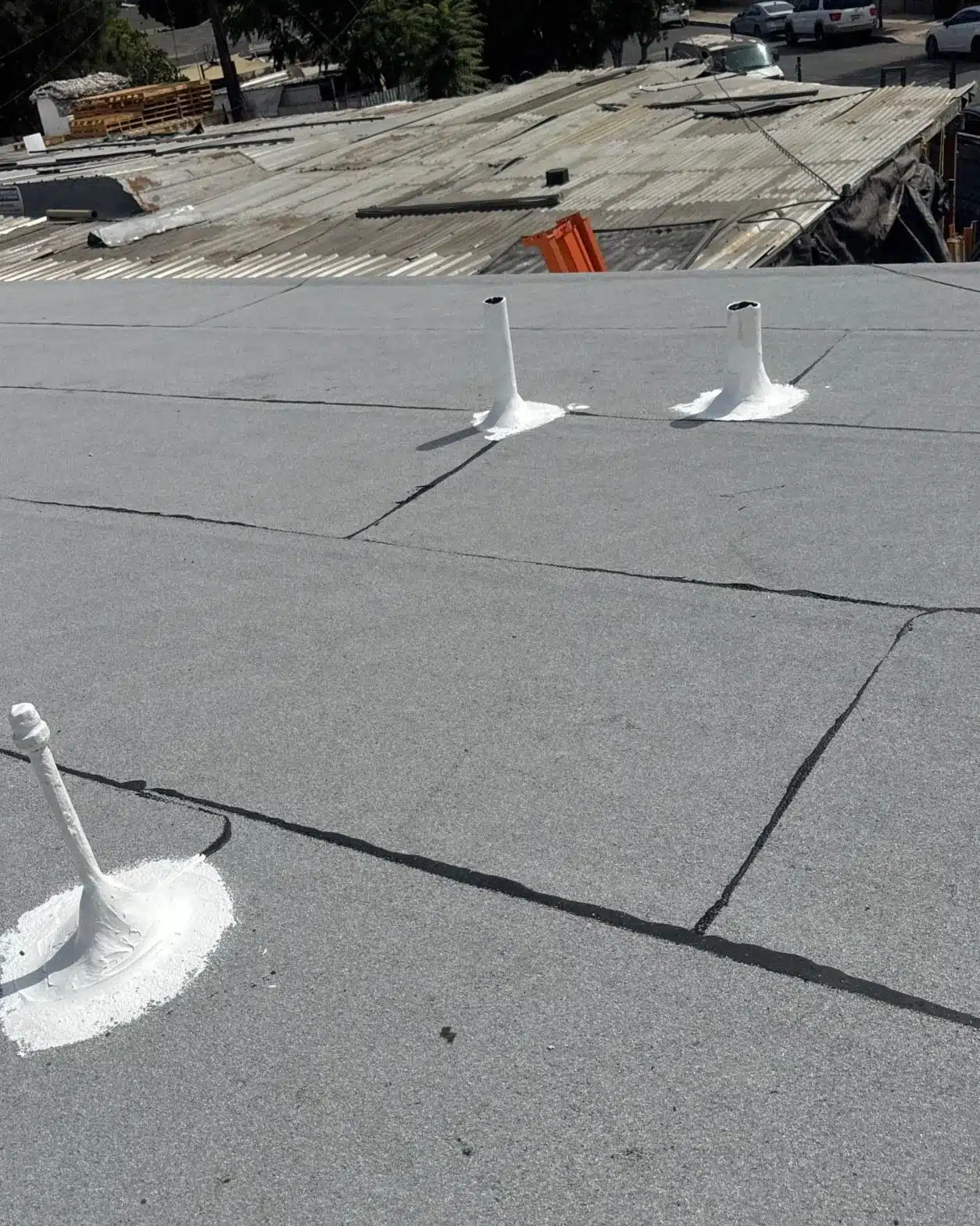
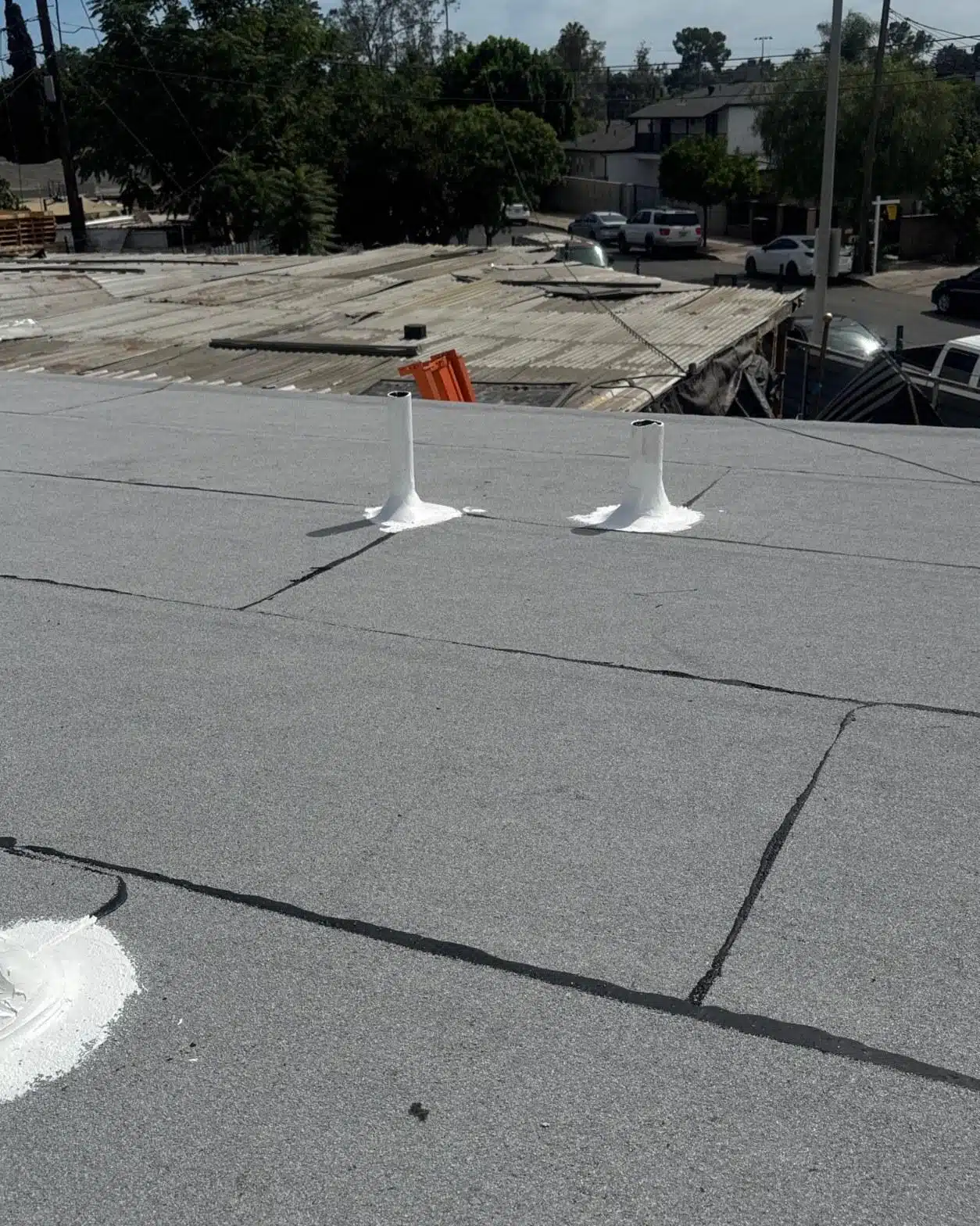
Every roof penetration is a potential water entry point, and sealing them correctly into the new membrane is as important as the field installation itself. On this project, three pipe vents and two turbine vents needed to be integrated into the finished system. Each penetration received a dedicated boot or base flashing torched into the cap sheet, then sealed around its perimeter with a white elastomeric sealant that bonds to both the granule surface and the metal or PVC boot collar.
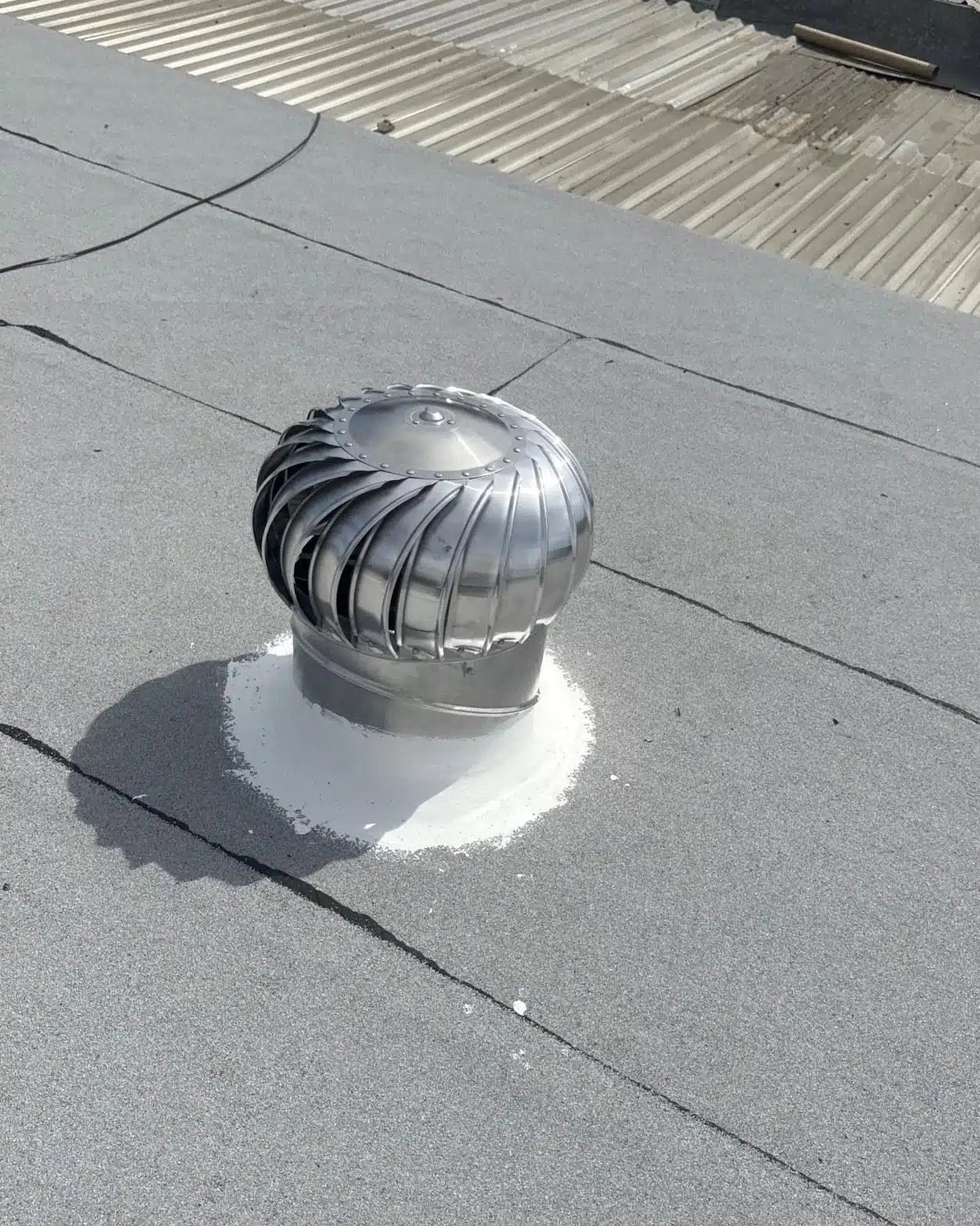
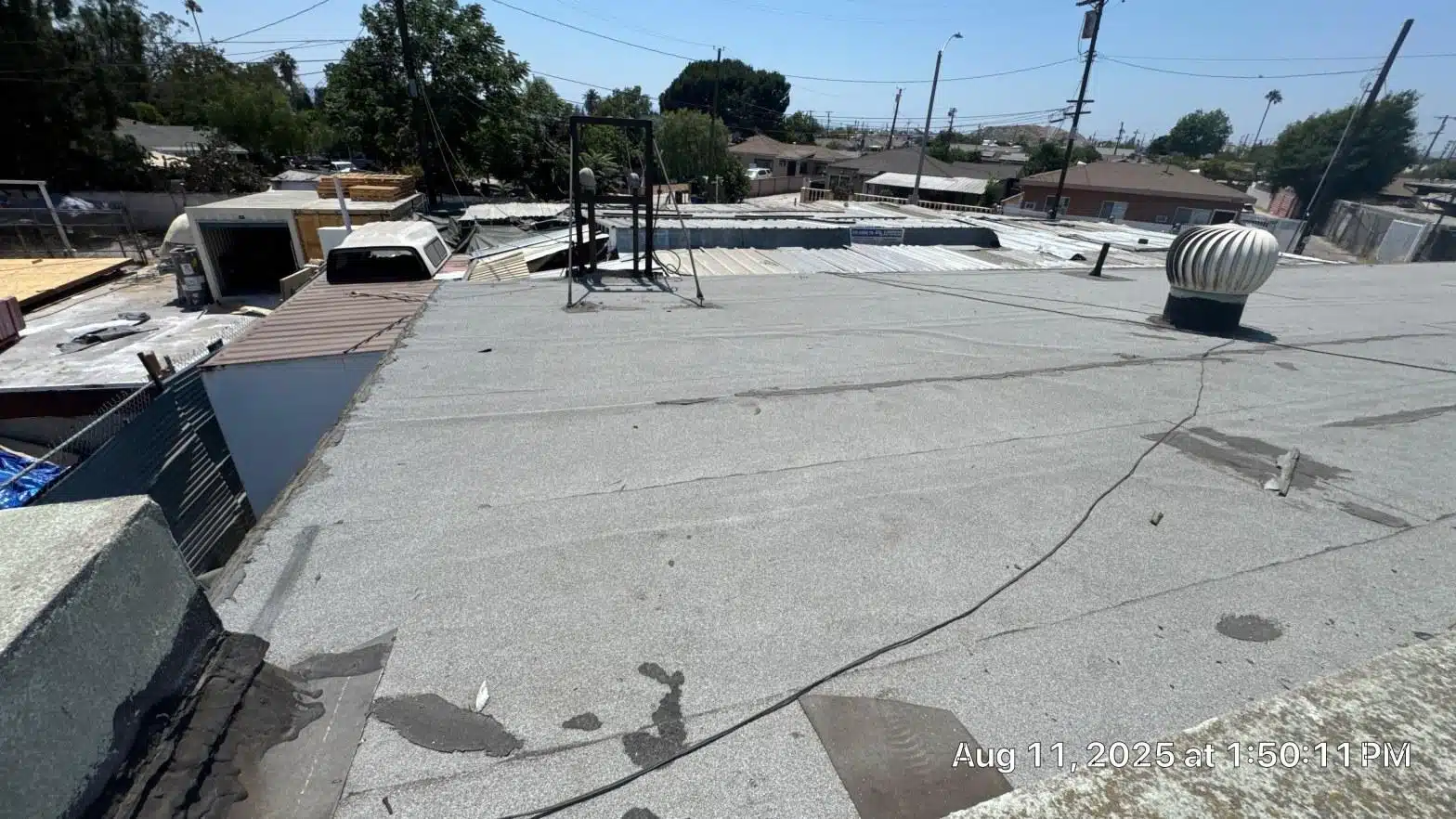
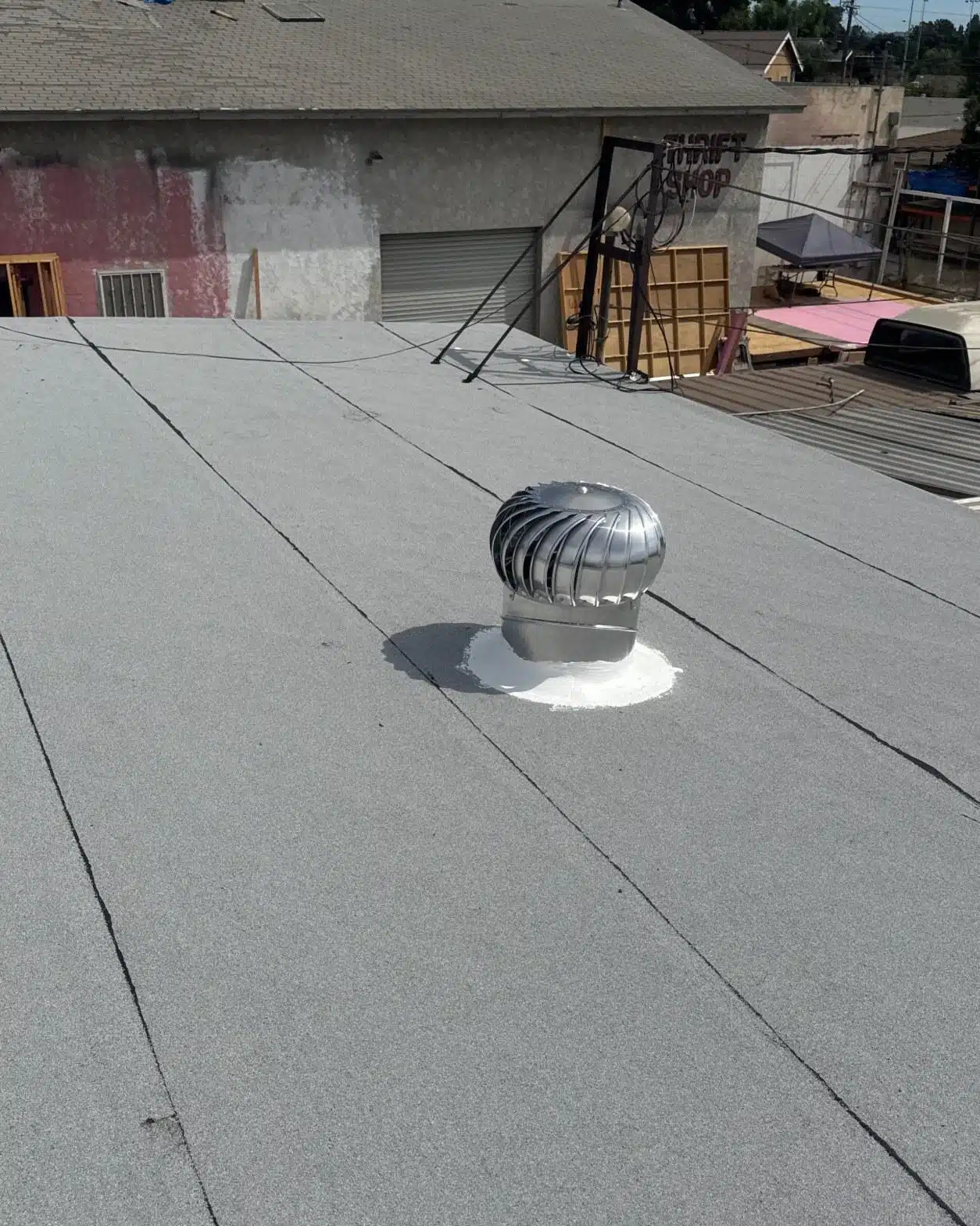
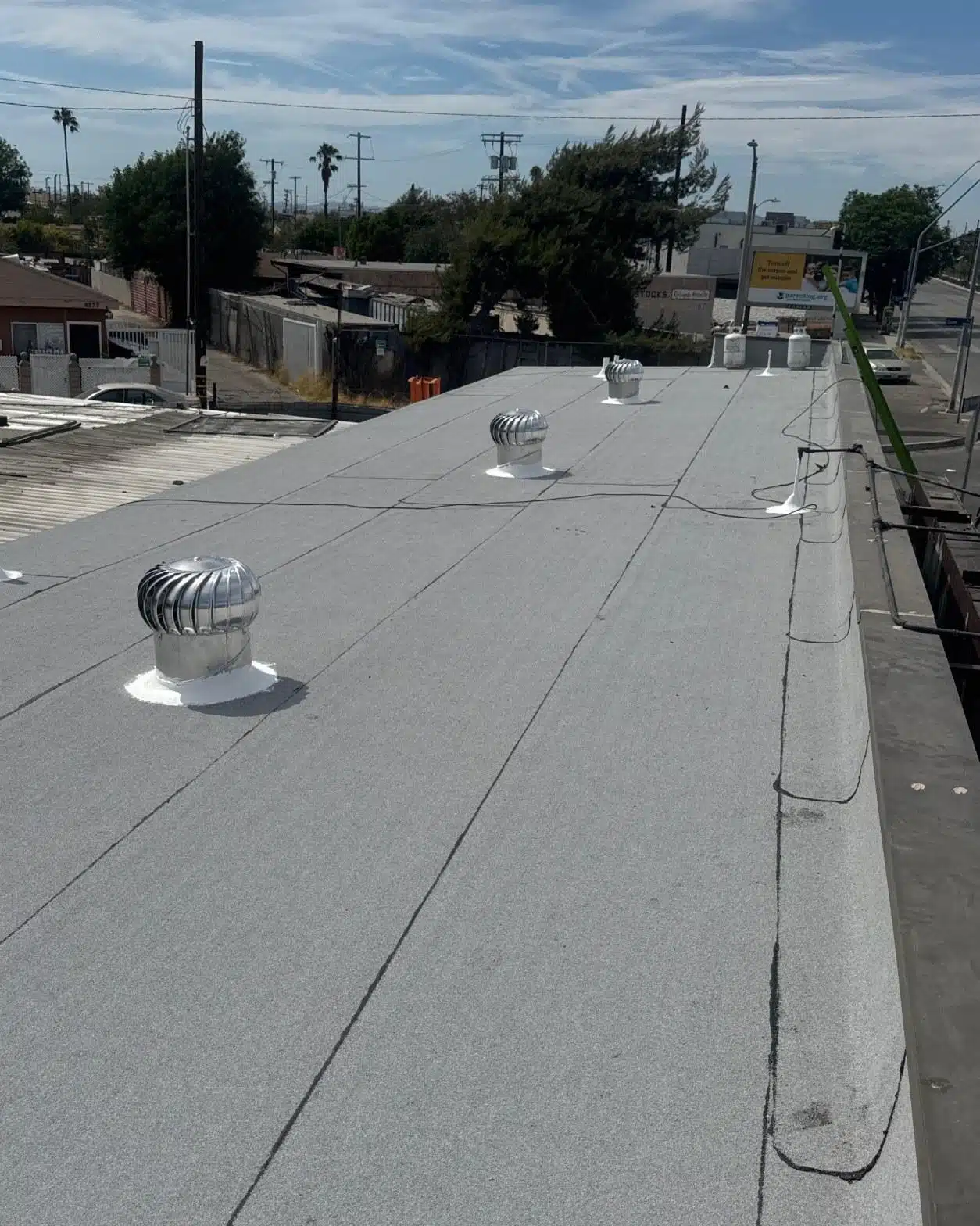
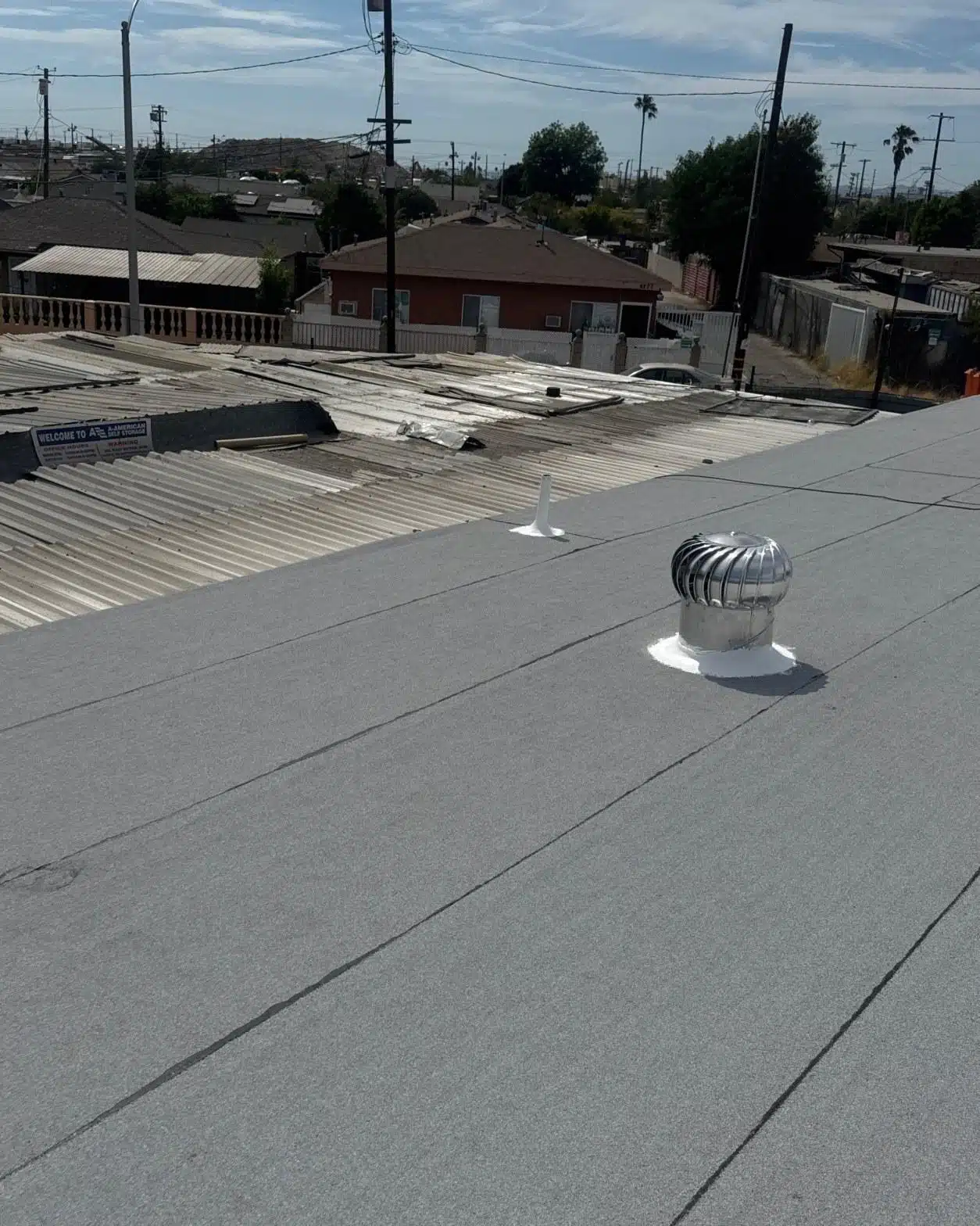
The close-up of the completed stainless steel turbine vent shows exactly what a properly finished penetration looks like: the base flange is fully embedded in the membrane, and the sealant collar spreads outward in a smooth, unbroken ring with no gaps at the metal-to-membrane transition. Stainless steel turbines resist the corrosion that affects painted steel units within 3 to 5 years in coastal Southern California air. The turbine vents serve the attic or plenum space below, passively exhausting heat without any mechanical components or electrical draw. According to the U.S. Census Bureau, Los Angeles County contains more than 3.3 million housing and commercial units, a large share of which rely on passive ventilation strategies exactly like these.
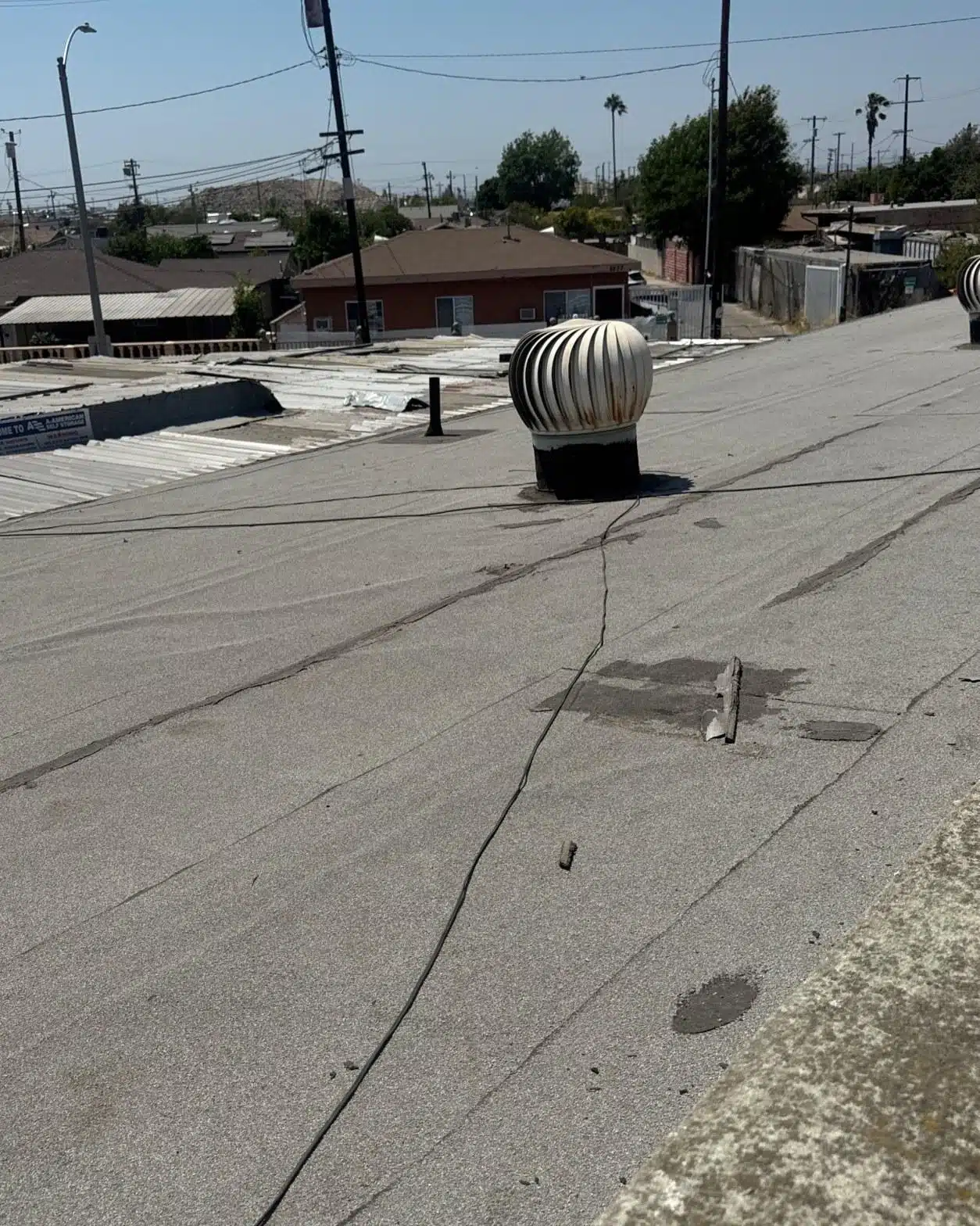
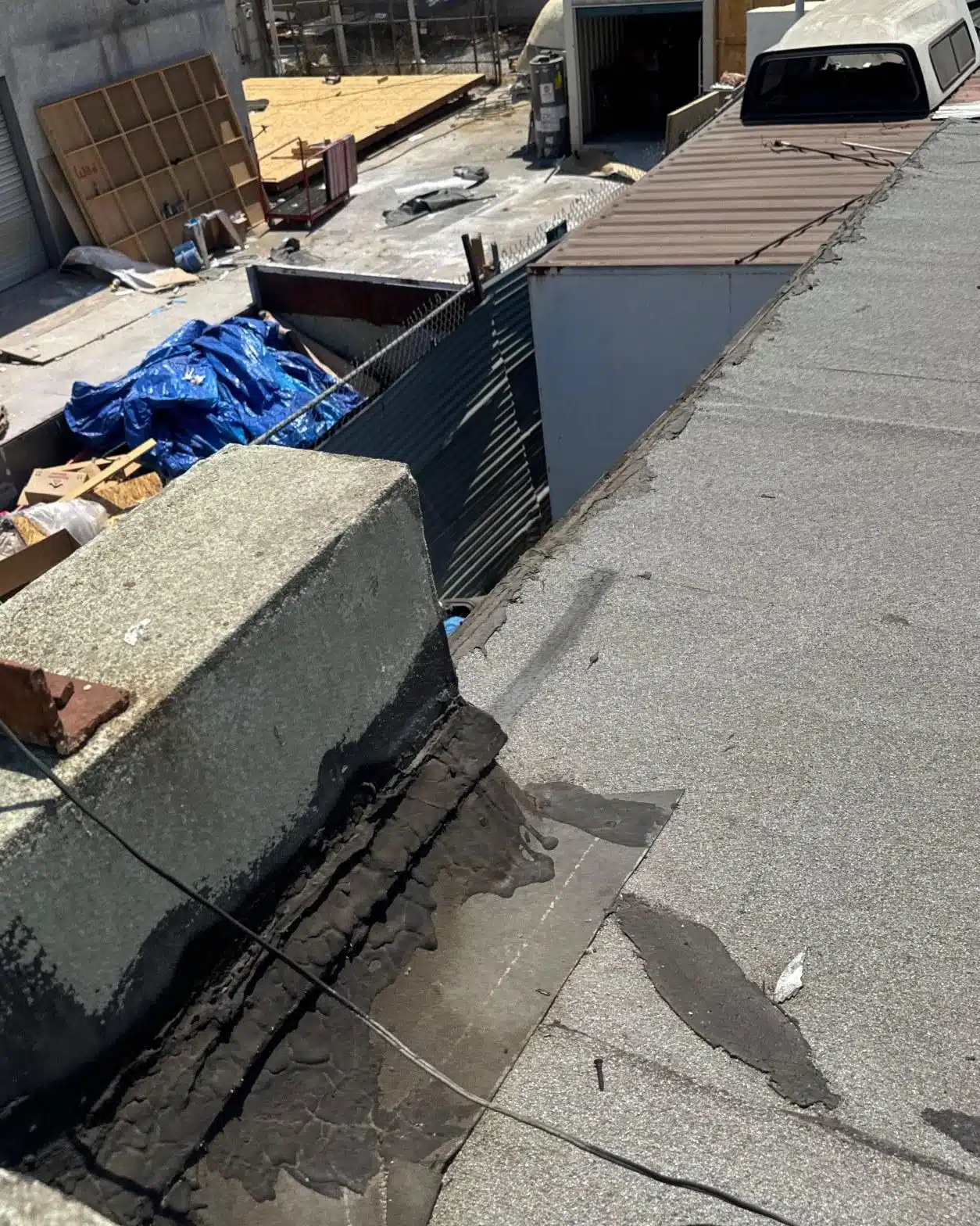
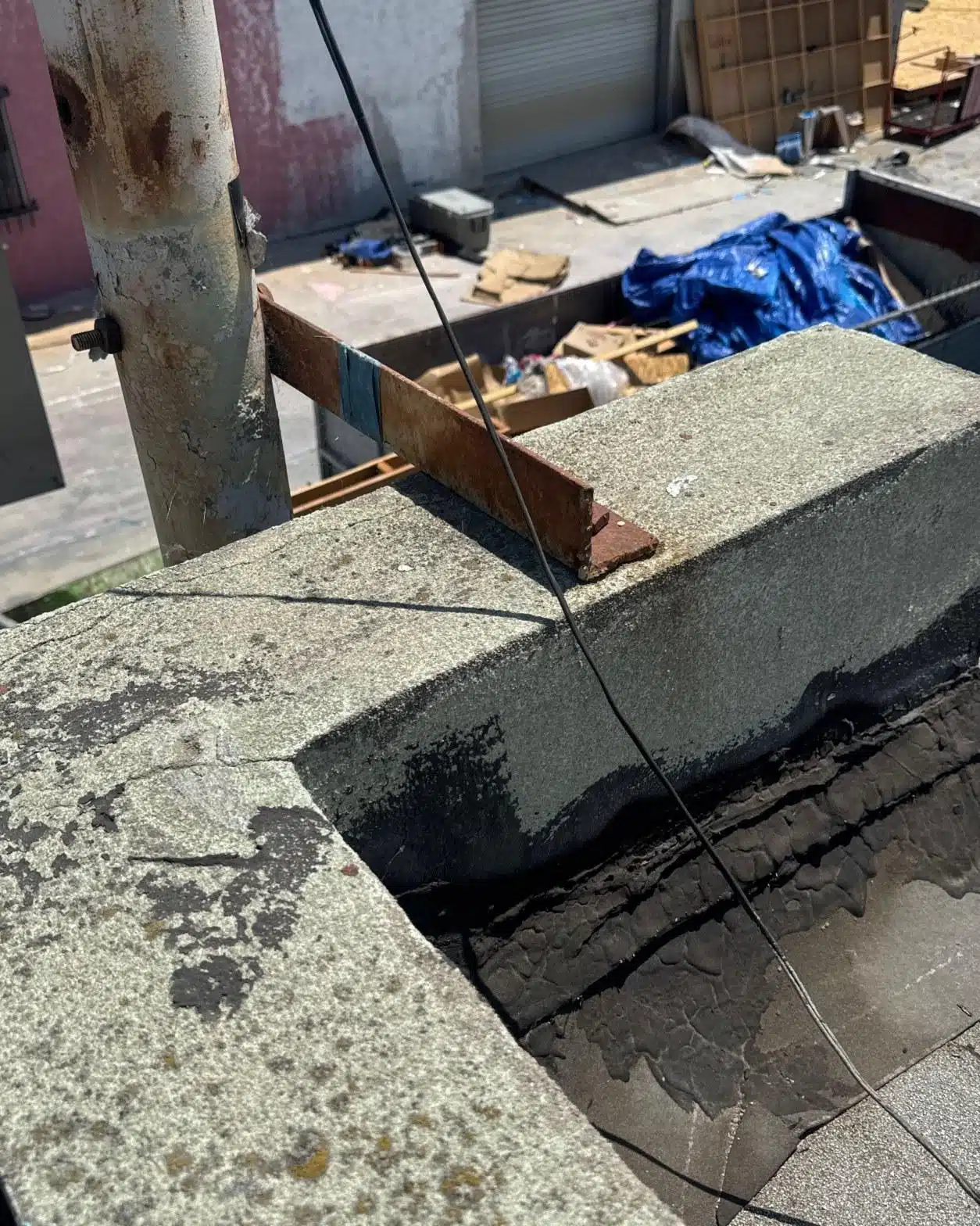
The three pipe boot penetrations visible in the gallery photos received the same elastomeric seal treatment, with the boot base torch-welded into the cap sheet before the sealant collar was applied. This two-stage approach, mechanical bond plus sealant, is the specification detail that separates a 15-year roof from one that leaks at the first heavy rain.
Project Outcome
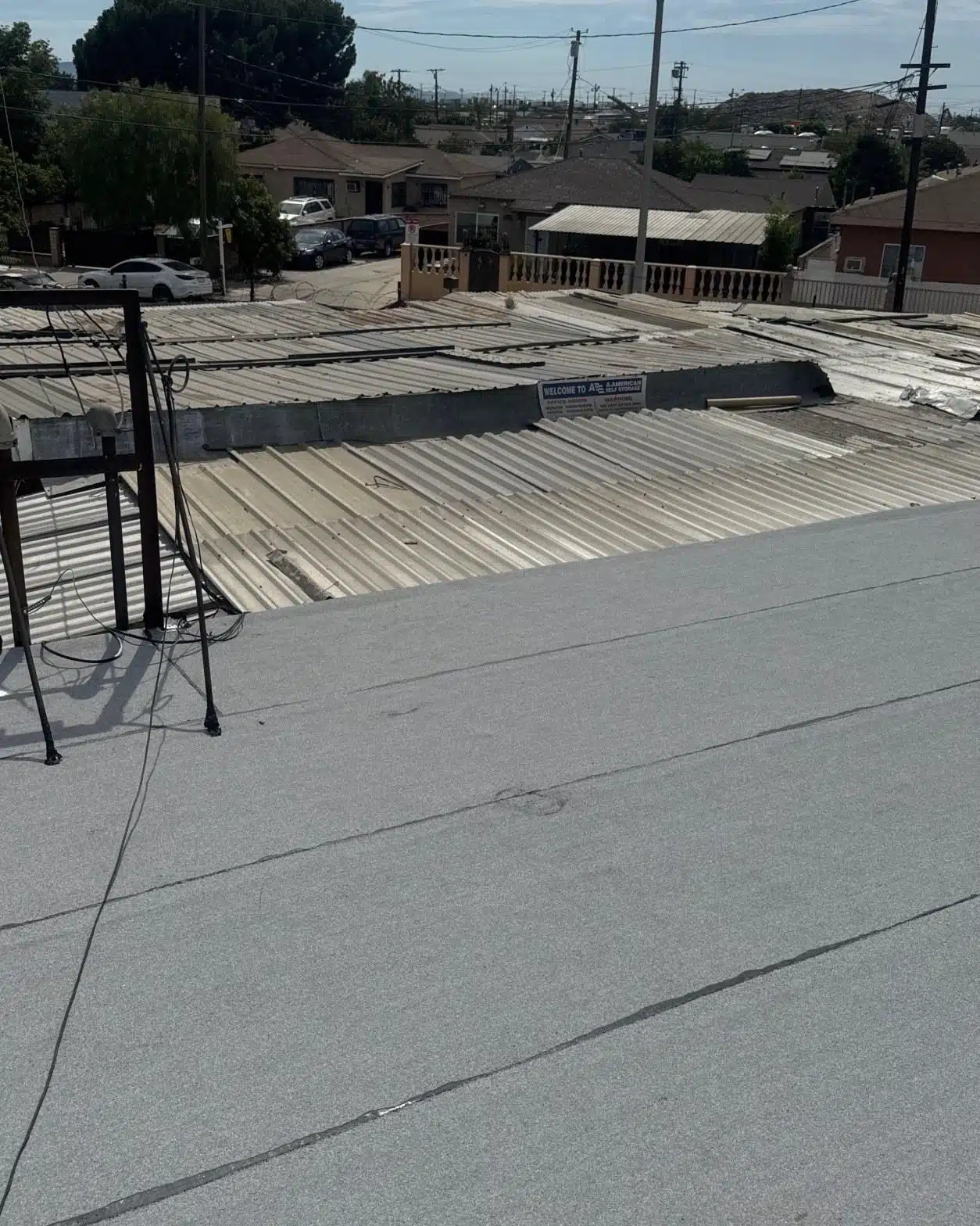
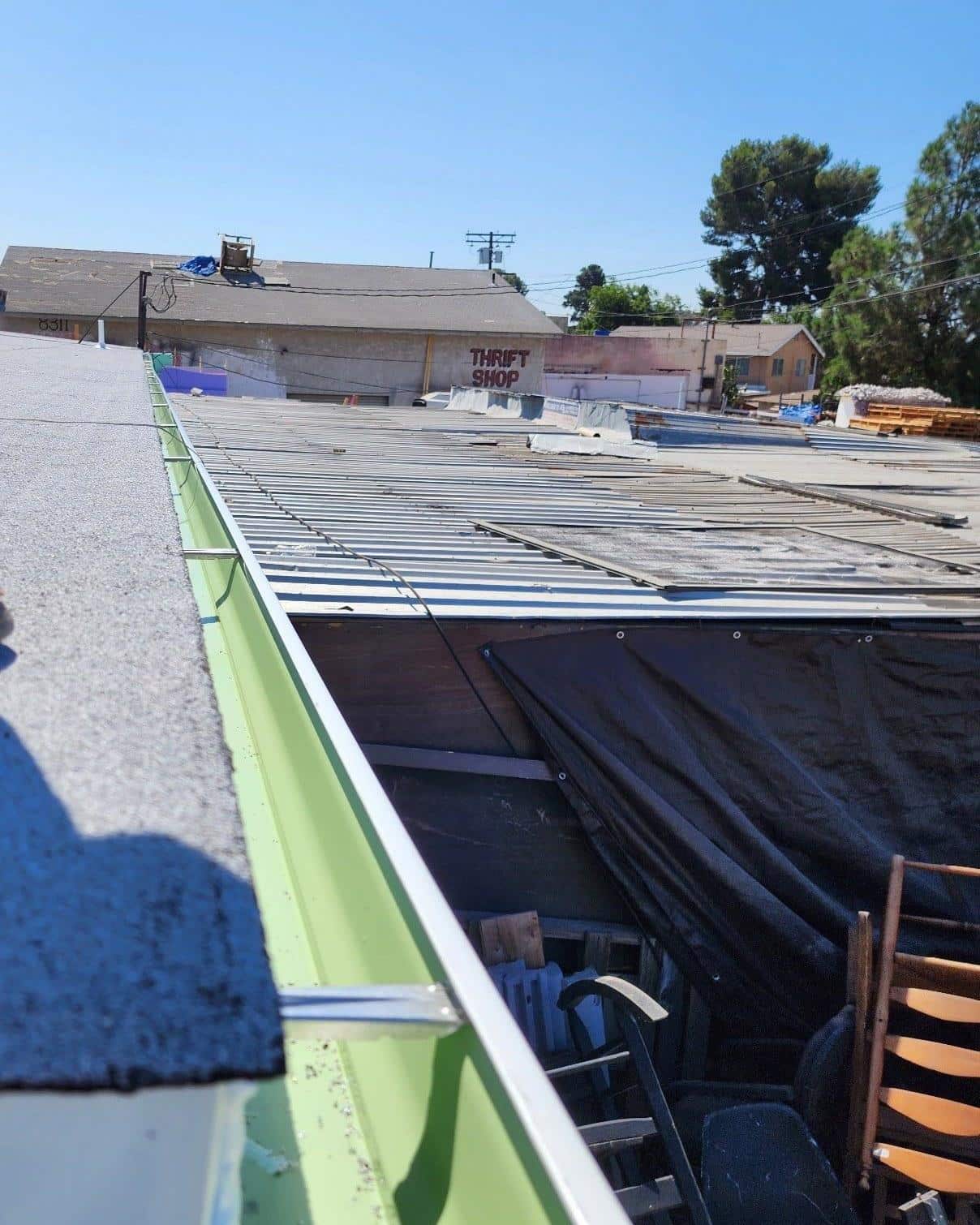
The roof was complete by the afternoon of August 19, 2025, two days after the tear-off began. The finished surface is a continuous granule-cap modified bitumen membrane with all penetrations sealed, perimeter edges terminated at the parapet, and the turbine vents operational. The building owner now has a roof system built to perform through Southern California’s rain season without patching or emergency calls.
If your commercial property has a flat or low-slope roof showing blistering, ponding, or membrane separation, the same full replacement process is available through Roof Repair & Construction Inc. Call to schedule a site inspection and written scope before the next rain event arrives.
Gallery
Explore our full range of Roof Repair services across Southern California.
Frequently Asked Questions
How long does a commercial flat roof replacement usually take?
A full tear-off and modified bitumen re-roof on a single-story commercial building typically takes 2 to 4 days, depending on deck size and the number of penetrations. This project was completed in 2 days, from tear-off on August 17 to finished membrane on August 19, 2025.
How long should a torch-down modified bitumen roof last?
A two-layer torch-applied modified bitumen system on a properly prepared deck typically lasts 15 to 20 years in Southern California conditions. Longevity depends on correct installation at seams and penetrations, as those are the points where early failures most commonly originate.
Is it better to overlay an old flat roof or do a full tear-off?
A full tear-off is almost always the better choice when the existing membrane has failed or shows widespread delamination. Overlaying a failed membrane traps residual moisture and can reduce the life of the new system. A tear-off also allows the deck to be inspected and repaired before new material goes down.
Why are the turbine vents on my flat roof leaking around the base?
Turbine vent leaks almost always occur at the base flashing, either because the original boot was never properly torched into the membrane or because the sealant collar has cracked over time. The fix is to re-flash the base into the existing membrane and apply a fresh elastomeric sealant collar, or to replace the penetration as part of a full re-roof.
What is the difference between a base sheet and a cap sheet in modified bitumen roofing?
The base sheet is the first ply, a reinforced asphalt layer torched directly to the deck that provides structural bond and an initial water barrier. The cap sheet is the second ply, surfaced with mineral granules, and it serves as the finished weather surface that resists UV exposure and foot traffic.
Does California's Title 24 apply to commercial flat roof replacements?
Yes. California's Title 24 building energy standards set minimum solar reflectance requirements for low-slope commercial roofing on buildings subject to the code. Granule-surfaced modified bitumen cap sheets in light colors, like the gray finish used on this project, are commonly specified to meet those reflectance thresholds and reduce cooling loads in Southern California's climate.